
 3 months ago
73
3 months ago
73
ARTICLE AD BOX
Manchester United boss Marc Skinner has backed Fifa ruling on more female coaches
ByAdam MillingtonBBC Sport journalist and Joe BradshawBBC Sport senior journalist
Fifa has implemented a landmark policy that teams in their tournaments must include female coaches.
Under the new ruling, at least two staff members on the bench of every team at matches must be women, with one in an assistant or head coach role.
The rules apply to international football and Fifa club competitions.
Looking across the top 10 nations in the world, six would already be compliant although only four of them have female head coaches.
But does action need to be taken in the English game?
In the Women's Super League (WSL), BBC research suggests three teams would currently comply with Fifa's rules. Only a third of WSL managers are female, while two clubs do not appear to have any female head coach or assistant coaches.
"To give equal opportunity, sometimes you need to inject," said Arsenal manager Renee Slegers. "I'm very proud to be part of Arsenal where there are so many women working at a really high level."
Fifa's requirements come into effect for the under-17s and under-20s Women's World Cup and Women's Champions Cup competitions later this year.
The rationale is to spark a rapid increase in female representation in coaching roles.
The Women's Super League says growing the number of female coaches is a priority and is taking a "thoughtful approach" in conjunction with the FA.
They point to a number of pathways already established such as the Coaching Initiative, mentoring and an elite female coaching programme, designed to improve access for women to the top levels of the English game.
Slegers added that anything the WSL could do, whether by regulations, influencing or role modelling, was "powerful".
'Something needs to be done' but 'let's see how it works'
At the 2023 Women's World Cup, 12 of the 32 head coaches were female, including England manager Sarina Wiegman.
Aston Villa's Natalia Arroyo, one of the four female WSL managers, said this is a "difficult subject" but agreed football needs to ensure women are being given opportunities.
"I appreciate that the organisations that can dictate what future we are building are making decisions that help women to get more opportunities," she said. "Let's see how it works."
Slegers echoed her thoughts, saying progress has been made since she retired from playing in 2018.
"I see coach educators, I see opportunities, I see at all different levels that it's growing, which is great," said Slegers. "I see federations making efforts and that's really good."
In 2024, then Chelsea manager Emma Hayes told the BBC she wanted football's regulators to come up with "creative ways" to address the lack of female coaches in English football.
We have to think of creative ways to get women into coaching - USA manager Emma Hayes
Manchester United boss Marc Skinner, who began managing in women's football a decade ago, said he "welcomed the move", with the caveat that coaches need time and space to learn their trade.
"It has got to be at the right experience level and exposure so that those people don't fail," he said. "They will learn more from their failures, but I think it is about opportunity as well as them being ready.
"With the players coming out of the game now, with the experiences they've had, there will be a rich vein of coaches coming through."
Alongside their positive reactions to the policy, the coaches consistently mentioned the need for adequate provision to be put in place to give players the opportunity to develop into coaches.
While the professionalisation of the women's game in England has raised on-field standards, Leicester manager Rick Passmoor cautioned against fast-tracking players into prominent roles.
"We've had trailblazers in the past and the bar is higher now," he said. "There must be pathways for players nearing the end of their careers. There are many roles they can step into.
"We need to make sure anybody - player or coach - gets experience on and off the pitch. On the pitch is 20% of the job; the rest is the 60 to 70-hour week."
Arroyo agreed, adding: "It is like [being] a teacher. It is not only about knowing the things that you are teaching - it is about knowing how to teach."
Players 'build equal relationships' with both male and female coaches
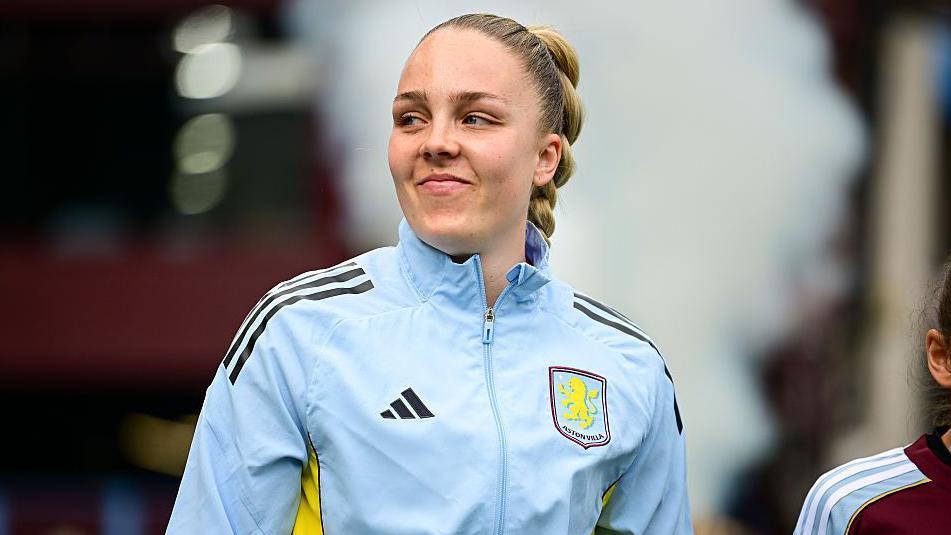 Image source, Getty Images
Ellie Roebuck joined Aston Villa from Barcelona in July
Aston Villa and England goalkeeper Ellie Roebuck, who plays under female coaches in Wiegman for the Lionesses and Arroyo at club level, told BBC Radio 5 Live the most important factor is "who is best equipped for the job".
"It is upskilling to make sure that we can develop female coaches so that they are in the best possible position to be the best possible candidate for the job," said Roebuck.
While Fifa's regulations have been brought in to increase access to top jobs for female coaches, Roebuck said the gender of their coach does not affect player-staff relationships.
"I don't think necessarily because they are female or male that it brings a different element to things," she said. "I'm just fortunate that I've been managed by Sarina and Natalia now and they are brilliant female coaches.
"It's easy to form a relationship with them, but that's not to say that I haven't had equal relationships with male coaches in the past either.
"The majority of the goalkeeping coaches I've had have been male, and I find it easy enough to build equal relationships with both."

Ben Haines, Ellen White and Jen Beattie are back for another season of the Women's Football Weekly podcast. New episodes drop every Tuesday on BBC Sounds, plus find interviews and extra content from the Women's Super League and beyond on the Women's Football Weekly feed

 English (US) ·