
 12 hours ago
11
12 hours ago
11
ARTICLE AD BOX
1 hour ago
Anthony Zurcher,North America correspondent in Maineand Ana Faguy
Graham Platner had just finished speaking to the crowd of several hundred at a town hall in Portland, Maine, when a supporter came on stage carrying a large, handmade card signed by dozens of attendees.
"We are your Graham-ily," she said, reading what was written around a large red heart, "and we've got your back."
The political novice - who went on to officially become the Democratic candidate for Senate after winning Maine's primary on Tuesday night - appeared visibly moved.
"I do this sometimes," he said, explaining the tear he quickly wiped away.
"This is a pretty hard thing to go through, to be entirely honest," he continued.
"And the only thing that really makes it bearable is going around the state of Maine and having as much support as we've gotten."
It had been a rough week on the campaign trail for Platner.

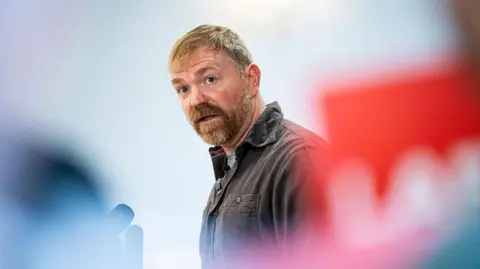 Getty Images
Platner's unconventional campaign has been a bumpy ride
On the eve of the election, he had been the subject of two damaging investigations by major national media outlets.
The past few months overall have been difficult.
There were reports about a tattoo on his chest resembling a Nazi symbol that sparked backlash, then online comments he made dismissing rape were unearthed, then stories that he was unfaithful to his wife were leaked to US news outlets.
But for those who turned out for his event at Elks Lodge #188 on Sunday night, none of that mattered. Their belief in Platner seemed undiminished.
"He's got a fantastic platform," said Kevin Claik, a retiree who drove 30 miles (48km) from the town of Naples to see Platner. "He's got a little bit of baggage, but who gives a shit? He is a saint here to me."
The durability of Platner's support reflects more than a year on the campaign trail, including – by his count - 83 town halls like the one in Portland.
It's the result of an effort that toppled the party establishment's choice in the Senate race, Maine Governor Janet Mills, and built a viral momentum that surprised political prognosticators and connected with the anger and energy of rank-and-file Democratic voters.
"I'm really excited for what the momentum that an unbought candidate might mean for the rest of the country," said Autumn Crisovan, who works in recreational sports in Portland and worries about the influence of deep-pocketed lobbyists in politics.
"It's nice to see there are people who are trying to fight and that it gets the ball rolling for everyone else."
Platner's campaign is a result, in part, of Maine's unique political environment.
With only 1.4 million residents, face-to-face politics still matters. And with a remote location at the north-eastern tip of the US, the population embraces the kind of rugged nonconformity that Platner represents.
"We've all seen this guy a million times," said Dana Bateman, a retail artist in Portland. "We want to see our politicians out and about. We want to ask them questions. We want to tell them what's on our mind."
But his rise also illustrates the depth of the partisan divide in America, where voters are prepared to overlook scandals that might have sunk past candidates in the pursuit of larger political victories.
After winning his primary on Tuesday, Platner becomes the Democratic nominee for Senate in a state that is pivotal to the party's hopes of winning control of the chamber in November's midterm elections.
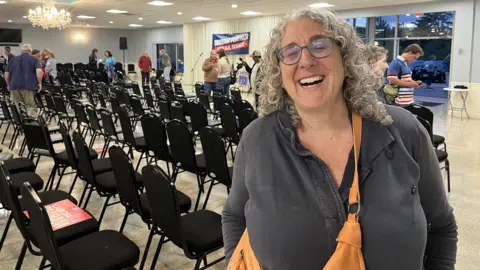 BBC/Anthony Zurcher
Dana Bateman
He takes on an incumbent, Susan Collins, who has beaten back political challenges for three decades in a state that no Republican has carried in a presidential election since 1988. And he walks into the general election race with a growing list of scandals that prompted heated debates within his own party – and that have Republican operatives licking their chops.
If he succeeds where other Democrats have failed, he could pull his party – and the US Senate – to the left and prove that novice candidates, baggage and all, can win big races in battleground states.
A defeat, however, would be viewed by national Democratic leaders as further evidence that their party's sometimes raucous left-wing is a liability that, like grassroots Tea Party conservatives in years past, can elevate candidates who may energise the base but are, ultimately, unelectable.
"If you believe, as I do, that we can change our politics and our country, then you must also believe that people can change. The reason I believe that is because I have lived it," Platner told a crowd of supporters on Tuesday night after his win in the primary vote.
An anti-establishment message resonates
Platner's success thus far is at least in part attributable to his life as a Marine Corps combat veteran turned oyster farmer and small business owner.
Mainers say they feel like they know the aspiring senator who is often on the campaign trail in jeans and a baseball cap and speaks candidly about everything from his personal struggles with PTSD after returning from war, to his and his wife's infertility journey.
As the American adage goes, Platner is the kind of guy voters feel they could have a beer with.
"People who know what it's like, who really know what it's like to work hard physically, and who know what it's like to face adversarial circumstances, and to figure out how to get beyond them, and [Platner's message] resonates with people more than somebody that just has good ideas and can say them articulately," said Cynthia Phinney, president of Maine's AFL-CIO labour union.
Platner argues his grassroots, not-billionaire-backed campaign offers an alternative to Collins that focuses on the people's issues, rather than politics and what is happening in Washington.
His message is anti-establishment and anti-elite.
He rails against entrenched wealth and promises "structural change" if elected.
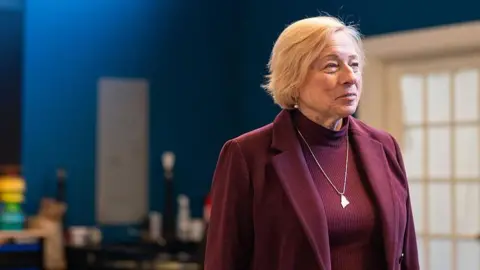 Getty Images
Governor Janet Mills exited the Senate race this spring, citing lack of money
His policies – which include universal government-provided healthcare, free college education and a wealth tax - draw from the left, including Vermont Senator Bernie Sanders and New York congresswoman Alexandria Ocasio-Cortez, whom he regularly praises on the stump.
As much as his relatable nature has helped, so too did the lack of a serious primary challenger ahead of Tuesday's race.
Maine Governor Mills had been urged to run by the national Democratic leadership, but she entered the race last autumn well after Platner's campaign had begun gaining traction.
She started behind in the polls and in fundraising, and she said that lack of money ultimately forced her out of the race earlier this spring.
As more and more details emerged about Platner's troubled past, some Maine voters said they felt like they had no choice but to back him if they did not want Collins back in Washington.
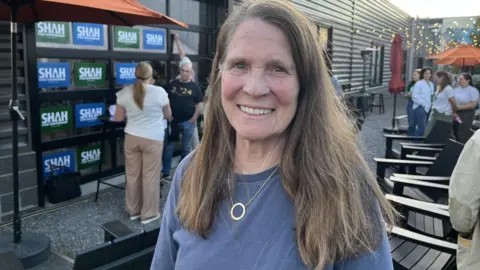 BBC/Anthony Zurcher
Ann Oliver
"I'm not changing my vote, although I hate him for it," said Ann Oliver, who lives in Portland.
"But you know we've been so jaded about what's OK and what's not.
"None of it's OK to me, but we can't really use it as an excuse anymore.
"I would vote for him exclusively to keep Susan Collins from winning."
A tattoo and sexually explicit texts
Platner's former political director, Genevieve McDonald, was the source of some of the negative news stories about him. And on Monday night, she wrote a Washington Post opinion piece expressing her concerns.
"Graham Platner is not someone who would be good for Maine or for the country," she wrote. "He exhibits a pattern of dishonest behavior that is impossible to ignore."
The BBC contacted the Platner campaign for comment, but did not receive a response.
Last week, in what some thought could be the nail-in-the-coffin for Platner, the New York Times published a report detailing the accounts of three former girlfriends who said he could be angry and erratic.
One former girlfriend told the Times that Platner "regularly grabbed her by the shoulders - sometimes hard enough to leave marks - and, on one occasion, yanked her out of a cab by her wrist after an argument when she wanted to stay in the car".
Platner has denied the allegations – but even for some of his political supporters, that may not be enough.
Ro Khanna, the left-wing Democratic congressman from California, campaigned with – and defended – Platner at a rally in Bar Harbor on Friday, the day after the New York Times story came out.
In a Sunday interview on NBC News, he was pressed to explain that support.
"I believe what he did was wrong, was misogynistic, was toxic or volatile," Khanna said.
"I know he's ashamed of it, and I certainly think it would be appropriate to apologise and say how he now understands why it's important to stand up to a misogynistic culture."
In other instances, Platner has been quick to apologise and admit where he has been wrong.
Platner removed the tattoo, which appears to resemble the "Totenkopf" - German for "death's head" - used by Nazi forces during World War Two.
He said he got the tattoo in Croatia with his fellow Marines in 2007 while drinking.
They picked the image off the parlour wall, he said.
"I absolutely would not have gone through life having this on my chest if I knew [what it meant]," he said in his apology.
When the Mills campaign unearthed old Reddit posts where Platner said victims of sexual assault should "take some responsibility for themselves and not get so [expletive] up", Platner asked voters for forgiveness.
"Maine, I am asking you not to judge me for the worst thing I said on the internet, on my worst day 14 years ago, but who I am today and the kind of senator I promise to be," he said in an ad addressing the remarks.
And when the allegations that Platner had exchanged sexually explicit texts on a messaging app with women outside his marriage, he acknowledged they were true.
"At the beginning of our marriage, I made mistakes, and Amy held me accountable for them, and we worked through them, and the work that we did made our marriage significantly stronger, and who we are today is an incredibly faithful and happy married couple," Platner said in an interview on MS Now.
Novice candidates like Platner have become a hot commodity in American elections of late.
At a time when professional politicians are broadly condemned for being too slick and too programmed, an "ordinary American" on the ballot has a certain charm.
Amanda Litman founded Run for Something in 2017 to recruit and train new Democratic candidates for all levels of public office – including ones, she says, who weren't perfect.
"Voters will forgive a lot as long as you are honest with them, and as long as they can see how you've changed," she said. "The thing that really makes that a powerful story is that you are being honest and authentic."
Authenticity, a buzzword in today's politics, builds trust. And while Platner was initially effective in weaving those early negative stories into a redemption narrative, Litman says that new waves that hit his campaign risk alienating the voters and betraying that trust.
A formiddable general election opponent
According to a recent survey conducted by conservative pollster Tony Fabrizio for the Collins campaign, the latest revelations have increased the number of Maine voters who have a negative view of the Democrat by 20 points – from 29% to 49%.
The race between the two candidates, however, was tied at 46% - hinting at the long, gruelling general election campaign in store.
"It is clear that the more voters learn about Platner the more they find they don't like him, making the Senate race highly competitive," Fabrizio wrote in an internal memo that was printed by Politico. "Senator Collins and her allies need to muster the resources to keep the pressure on Platner as the Democrat money machine tries to salvage Platner's candidacy."
With a CV that spans 30 years and ties to Maine voters that run deep, Collins is a formidable candidate. She is a moderate Republican who often, but not always, backs Trump.
She voted to convict Trump following his 2021 impeachment, but she has confirmed many of his political appointees and stuck with her party in closely contested votes.
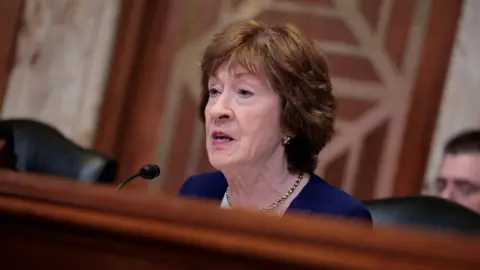 Reuters
Senator Susan Collins, a moderate Republican, is a formidable opponent
"Susan Collins is always there when we need her," the late conservative activist Charlie Kirk said early last year, after the senator backed Tulsi Gabbard, one of Trump's more controversial Cabinet appointments.
She also boasts a political war chest that has more than $20m between her campaign and affiliated committees – dwarfing the $2.7m Platner has in the bank. That money will soon unleash a torrent of negative advertising against Platner, focusing on his chequered past in an attempt to define the Democrat before he has a chance to introduce himself to general-election voters.
Both sides will be trying to convince Mainers like Maureen Lonsdale, who said she knows Collins and has concerns about her recent ties to Trump, but needs to learn more about Platner.
"I'm kind of up in the air," she says, adding that she met Collins years ago. "I'm an independent, and I'll do some more research."
During his town hall in Portland on Sunday, Platner noted how Democrats had been trying – and failing - to unseat Collins for three decades. They had tried established politicians in the past to no avail.
Platner, for all his apparent flaws, has strengths that prior Democrats may have lacked. His campaign boasts of its grassroots network, with more 11,000 volunteers on its volunteer rolls.
And while Collins has more campaign cash on hand, Platner has raised more than $14m overall and developed a national Democratic donor base.
In past elections, Collins has succeeded because she's won over voters who have backed Democrats for president. Platner, with his working-class pitch, might peel away some of the rural voters who backed Trump in the past three presidential elections.
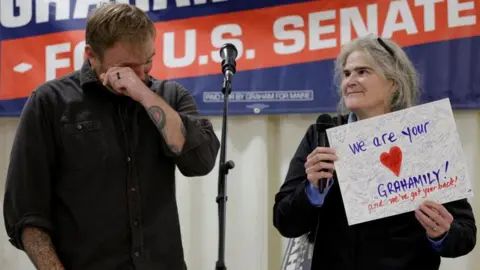 Reuters
Graham Plater appears emotional on the campaign trail
"This is a race about style, and he is straight out of central casting for a firebrand politician who doesn't take any bullshit," said Nick Jacobs, a politics professor at Colby College in Waterford and co-author of The Rural Voter: The Politics of Place and the Disuniting of America.
"There's certainly parts of Platner's candidacy and persona that resonate in the types of communities I study and I live," he said. "There is a deep connection to place that seems genuine, because it is quite pervasive throughout his style and substance."
Like Trump, Platner also leans into an appeal to political nostalgia – of a time when things were simpler and life was easier.
He talks about how someone could do odd jobs, shovel driveways, dig for clams and still afford to own a home, put their children through college and save for retirement.
"That hardscrabble work, that incredibly hard work that Mainers have been proud of doing for generations, it used to be enough," he said.
Platner may need another Trump-like quality - an ability to shake off scandal and turn his personal flaws into an advantage - if he wants be Maine's next senator.
During the 2024 presidential campaign, Trump used to tell his supporters that his critics weren't after him, they were after them. "I'm just in the way," he said.
On Sunday night, Platner offered a similar verse.
"What everybody fails to understand in the rest of this country is they think this is a race that looks like all the other ones. They think this is a race about me," he said in a speech to supporters outside the meeting hall.
"What they don't understand is this is a race about us. It's about the people of Maine.
"It's about the recognition that only in each other, only in our communities, do we find the power necessary to take back our politics."

Follow the twists and turns of Trump's second term with North America correspondent Anthony Zurcher's weekly US Politics Unspun newsletter. Readers in the UK can sign up here. Those outside the UK can sign up here.







 English (US) ·