
 3 hours ago
9
3 hours ago
9
ARTICLE AD BOX
11 minutes ago
Margarita RodríguezBBC News Mundo

 Getty Images
Football is life for millions of fans around the world, but in two of the co-host nations of the 2026 World Cup, they tend to call it by a different name.
In the US and Canada, it's known as soccer. But why? And does that word annoy other football-loving nations?
"When I was a child in England, the word 'soccer' was perfectly acceptable," Stefan Szymanski says.
The emeritus professor at the University of Michigan, who grew up in the 1960s and 1970s, says the debate around "football" versus "soccer" struck him as strange.
"I started asking my friends: 'Do you remember? Maybe it's a false memory. Was it ever a problem?' I began talking to people about it. And the consensus was that in the 1970s there didn't seem to be any issue with that word."
Szymanski's interest turned into research.
He explains that, in its early days, football was a very "posh" sport.
"The people who founded the Football Association in England in 1863 were Oxford graduates who had attended elite public schools," he said.
The game played under Football Association rules became known as "association football", wrote John M Cunningham in the Encyclopaedia Britannica.
The name also helped distinguish it from another popular sport: rugby.
"There were two games: one called rugby football, at that time, and the other called association football," says Szymanski.
Among wealthy university students in the 1880s and 1890s, there was a habit of shortening words and adding "-er" to the end, creating a kind of slang.
"So instead of saying 'breakfast,' they would say 'brekker'."
Applied to rugby, they would call it "rugger."
So how did the word "soccer" emerge?
There is a theory, Szymanski says - though he cautions that "no-one is entirely sure".
It appears that these inventive students took "soc" from the middle of the word "association" and added "-er," producing "soccer".
"Obviously, no-one knows for certain, but what people are sure about is that it comes from Oxford. There are many documentary sources confirming that it was a word coined by students there."
 Getty Images
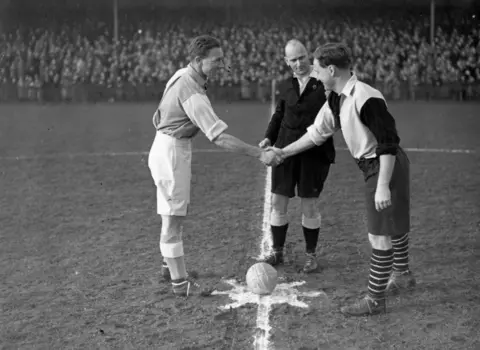
Opposing captains shake hands before a match in 1938. On the left is H S Seaford, of Oxford University, and F E Templer of Cambridge on the right
Soccer spreads to Canada, the US and more
Sports historian Andy Mitchell has pointed to "at least" three examples of "soccer" or "socker" appearing in school magazines in late 1885 in different parts of England.
"My intuition is that 'soccer' and 'rugger' were already being used verbally and had appeared in print earlier that year (1885) in another, as yet unidentified, publication," Mitchell wrote on his blog Scottish Sport History.
Over time, the "socker" variant fell out of use, while "soccer" remained.
The word began travelling to other continents at the same time the sport itself was spreading, and soccer is now often used in Australia, New Zealand, South Africa and Canada.
In the United States, "football" refers to American football.
"It's all connected," says Szymanski. "The American version evolved from rugby, but it also has elements of soccer."
"They're like close cousins - and that's why American football became popular around the same time the word 'soccer' was coined, in the 1880s and 1890s."
While British newspapers preferred "football", they continued using "soccer" well into the 1980s, according to analysis by Szymanski and his colleague Silke-Maria Weineck.
Over time, however, "football" became the dominant term.
Szymanski said the two terms come up when he teaches classes at university: "Something Americans tend to do is apologise when they use the word 'soccer' and say, 'Sorry, I meant football,' because they think the British are sensitive about it.
"And they're right - some are.
"I think it's very polite of them to apologise, but I tell them: 'It's an English word - feel free to use it.'"









 English (US) ·