
 2 months ago
59
2 months ago
59
ARTICLE AD BOX
14 minutes ago
Paul SeddonPolitical reporter

 Getty Images
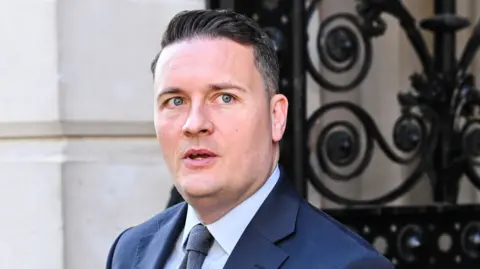
Wes Streeting has spent much of the last year insisting he was not about to launch a leadership bid against Sir Keir Starmer.
That continues to be his position in public - but we don't yet know what he told the prime minister in a brief meeting in No 10 earlier on Wednesday.
The 43 year-old health secretary has made no secret of his desire to hold the top job one day, although he had previously denied he would challenge Sir Keir directly.
He is not the only high profile figure at the centre of leadership speculation - but unlike Angela Rayner and Andy Burnham he is a member of Sir Keir's cabinet.
Streeting is regarded as one of Labour's best communicators, and has regularly been sent out to defend the government in the media.
His supporters believe he has the political skills and fluent style to sell the party's message more effectively than the current leader but as a figure on the right of the party he might struggle to appeal to more left-leaning colleagues.
During one fevered bout of leadership speculation last autumn, Streeting was forced to deny suggestions from the prime minister's allies he was planning to move against him the wake of November's Budget.
The briefings, he insisted, were the "worst attack on a faithful" since rugby player Joe Marler had been banished in the finale of hit TV show Celebrity Traitors.
Formerly regarded as close to Lord Mandelson, Streeting has distanced himself from the former Labour minister since his sacking as US ambassador, saying earlier this year he would never speak to him again.
In what was seen as an attempt to minimise doubts among potential supporters, he took the unusual move of releasing private messages he had exchanged with the peer, insisting they had never been close friends.
 Getty Images
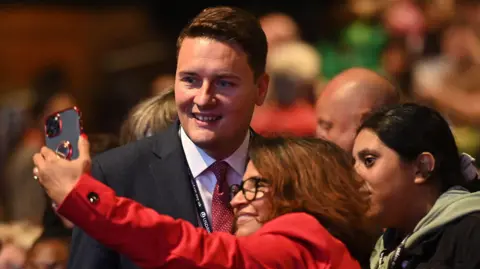
Streeting poses for selfies with supporters at the 2021 Labour conference
Born in east London in 1983 to teenaged parents, Streeting grew up in poverty, in what he has described as a "grotty" council flat in Stepney.
His two grandfathers, both named Bill, were key figures in his early life, later providing inspiration for the title of his 2023 memoir.
His maternal grandfather served time in prison for armed robbery, whilst his grandfather on his father's side was a "traditional working-class Tory" who had served in the Navy during the Second World War.
He has said his upbringing left him "quite cynical" of the role of the state compared with many Labour colleagues, aware of its failings as well as its potential to enable opportunity.
After attending a central London comprehensive school, he read history at Cambridge, becoming the first in his family to go to university.
During his second year he came out as gay, something Streeting, a practising Anglican, says he found hard to reconcile at the time with his Christian faith.
Streeting was obsessed with Labour politics from an early age, which, he told FE Week, made him unpopular with his schoolmates.
"I won a book token in a school competition and bought a collection of speeches by Tony Blair and read it on the coach to and from games.
"I mean, what sort of kid reads Tony Blair's speeches on the bus? I was asking for it really."
In his final year at university, he ran a successful campaign to become president of Cambridge University Students' Union - the traditional launchpad for a career in politics.
And in 2008, he was elected president of the National Union of Students. The "thick skin" he had developed at school helped him through his two year stint, when he was a frequent target of criticism, he later said.
He further honed his campaigning skills in various charity sector jobs and in 2010 was elected as a Labour councillor in Conservative-run Redbridge council.
He became deputy leader in 2014 when Labour took control of the council, before entering Parliament at the general election the following year as MP for Ilford North, the marginal north-east London seat he has held ever since.
Streeting, a prominent critic of the party's leftward turn under Jeremy Corbyn, campaigned for Remain at the Brexit referendum and was among Labour MPs who backed the idea of a "people's vote" on the final exit deal.
He had to wait until Starmer replaced Corbyn in 2020 before getting a seat on Labour's frontbench, first as a shadow Treasury minister and then shadow schools minister.
Just a year later he was promoted into the shadow cabinet during a reshuffle, in the short-lived position of shadow secretary of state for child poverty.
But it was as shadow health secretary, a role he has held since November 2021, that his political career took off.
His appointment to the role came just a few months after receiving a shock diagnosis for kidney cancer at the age of 38, which saw him undergo surgery before eventually declaring himself cancer-free.
The experience left him with a mixed view of NHS performance - he says he was seen quickly and received care from an outstanding surgeon, but was also sent for a wrong scan and had to deal with delays to follow-up treatment.
 Getty Images
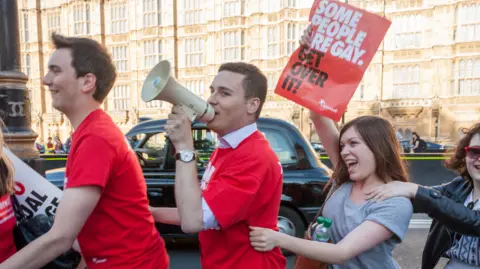
Streeting threw himself into the campaign to legalise gay marriage before becoming an MP
Streeting came close to losing his seat in the 2024 general election, seeing his majority cut to just 528 by a pro-Gaza independent candidate - something that may prove to be a problem if he stands in Ilford North at the next election.
Entering the health department after Labour's return to power in 2024, he signed off on a huge pay rise for junior doctors, now known as resident doctors, in a bid to end the long-running strike action they had launched under the Tories.
But the move failed to bring an end to their industrial action, leading to an increasingly sour relationship their union, the BMA, which he has accused of "cartel like" behaviour in negotiations over pay.
As health secretary he has earned plaudits - including from from political opponents - for his ambitions to shake up the health service and give greater powers to patients.
He has become a strong advocate for decentralising the service, and an enthusiast for greater use of technology in healthcare, promising an "online hospital service" for nine conditions through the NHS app in 2027.
But he has also ruffled feathers in the sector with pledges to fire under-performing NHS managers and his willingness to describe the health service as "broken".
Meanwhile, his willingness to talk up the role of private providers in the NHS has drawn criticism from his critics on the left of the party.
He will need to use all his skills of persuasion to win over support outside his own wing of the party, as he plots a course to Downing Street.

 English (US) ·