
 2 months ago
68
2 months ago
68
ARTICLE AD BOX
27 minutes ago
Bernd Debusmann Jrat the White House

 Reuters
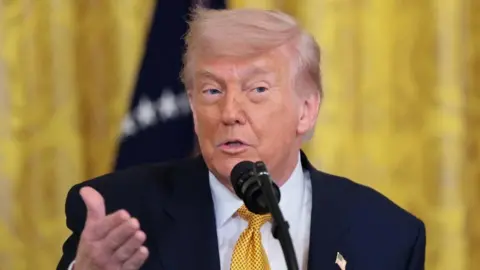
Donald Trump's pause on a short-lived "Project Freedom" to guide ships through the Strait of Hormuz, as he claimed progress had been made towards clinching a "Complete and Final Agreement" with Iran, soothed oil markets and sent hopes soaring of a breakthrough.
But expectations were soon tempered by the US president himself.
Iran said on Wednesday it was reviewing a new proposal from Washington, after US media cited unnamed American officials as saying that the two sides were closing in on a one-page memorandum to end the war in the Gulf.
A source close to mediators in Pakistan told Reuters news agency: "We will close this very soon. We are getting close."
But hours after posting on Truth Social on Tuesday evening that he was suspending Project Freedom to see whether "the Agreement can be finalized and signed", Trump abruptly changed tone.
He said on Wednesday morning that an Iran deal was a "big assumption" and if it was not agreed, bombing at "a much higher level and intensity than it was before" would resume.
The president's threat came less than 24 hours after US Secretary of State Marco Rubio said at the White House that Operation Epic Fury, the American-led military strikes of Iran, was over.
Later on Wednesday morning, Trump expressed optimism in a brief telephone call with PBS about prospects of an Iran deal, while acknowledging a breakthrough had previously proven elusive.
"I felt that way before with them," he said. "So we'll see what happens."
Trump also told PBS it was "unlikely" he would send US envoys for a second round of Iran peace talks in the Pakistani capital Islamabad.
Axios and Reuters had reported that Washington and Tehran were inching closer to a one-page, 14-point memorandum to end the war.
The plan would reportedly aim to bring hostilities to a close, which would then be followed by discussions to unblock the Strait of Hormuz, lift sanctions and curb Iranian's nuclear ambitions.
But Axios also reported scepticism among some US officials about the prospects for a deal and who would even approve such an agreement among the factions in Iran's leadership.
Iranian parliamentarian Ebrahim Rezaei, a spokesperson for Iran's National Security and Foreign Policy Commission, wrote on X that the 14 points reported by Axios amounted to a US "wish list".
He added that Iran "has its finger on the trigger and is ready" if the Americans did not "grant the necessary concessions".
In the US, foreign policy experts injected a note of caution, too.
"Clearly, the administration thinks a deal is possible, given the way they publicly rolled out Project Freedom only to suddenly pause it hours later," Grant Rumley, a former Middle East policy adviser to both the Biden and Trump administrations, told the BBC.
"But we have been here before, and we've seen negotiations collapse at the last minute for a variety of reasons," added Rumley, now a fellow at the Washington Institute for Near East Policy.
Trump has repeatedly said that Iran has agreed to US demands, and that a deal was close since an ongoing ceasefire was announced on 7 April.
On 17 April, he told CBS that Iran had "agreed to everything" and would allow the US to remove its enriched uranium – a claim officials in Tehran rejected outright.
In the Oval Office on Wednesday, Trump again maintained: "They want to make a deal, they want to negotiate."
"And we'll see whether or not they are agreeing," he added.
Watch: Captain of stranded ship in Strait of Hormuz tells BBC of 'pressure'
Even if a one-page memorandum was agreed upon, Rumley said that it was "highly unlikely" that it would solve all the issues, particularly given the highly technical aspects of an agreement on Iran's nuclear materials.
During the Obama administration, it took over 20 months for the finer details of a deal on Iran's nuclear programme to be ironed out.
Shipping experts said that Project Freedom, which was announced on Sunday, had a limited impact in its opening hours, with only a handful of ships passing through the strait.
Ali Vaez, Iran project director for the International Crisis Group think tank, told the BBC the Iranian response to the operation - which included shooting at ships and launching attacks on targets in the UAE - probably persuaded Trump it was "not going to solve the problem".
"There is no real policy process in this administration," he said. "The president makes decisions based on impulse more than process, therefore there are inconsistencies that happen all the time."
Mick Mulroy, a former assistant undersecretary of defence for the Middle East at the Pentagon, said any link between pausing Project Freedom and a possible peace deal remains murky.
"It's unclear if the pause in Project Freedom was because of this one-page memorandum or because the 1,500 ships currently stuck behind the [Strait of Hormuz] wouldn't transit even with the US security umbrella," he said. "Iran is likely trying to determine that as well."



 English (US) ·