
 2 months ago
42
2 months ago
42
ARTICLE AD BOX
42 minutes ago
Bernd Debusmann JrWhite House reporter

 Getty Images
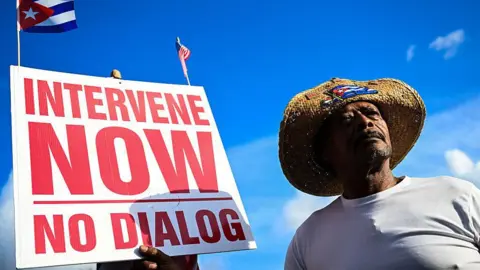
Many Cuban exiles in the US hope the Havana government is toppled
The US has charged Cuba's 94-year-old former president, Raúl Castro, with murder - stoking speculation that Havana could be next on Washington's regime-change list.
Amid a maximum pressure campaign that has led to the most significant fuel and energy shortages in Cuba in decades, a steady chorus of US officials is calling for the end of the island's 66-year-old Communist government.
While President Donald Trump has said that he believes no "escalation" will be necessary, the White House has also vowed it would not tolerate a "rogue state" 90 miles (144km) from US shores.
What comes next is anyone's guess: economic collapse, domestic turmoil or US military intervention. Here's three possible ways it could play out.
US could seize Raul Castro
The indictment of Castro on charges stemming from the 1996 shootdown of two civilian aircraft by Cuban fighter jets prompted immediate speculation that US forces could launch an operation to capture him and spirit him to an American courtroom.
Such an operation is not without precedent.
In January, US commandos launched a lightning-fast operation in Venezuela to capture President Nicolás Maduro - a longtime ally of Cuba - and bring him to New York to face drug and weapons charges.
In 1989, a much larger operation - Operation Just Cause - saw thousands of US troops invade Panama to topple and detain the country's then-leader, Manuel Noriega.
President Trump has so far brushed off questions about whether he is eying a similar operation in Cuba.
Several US lawmakers, however, have openly called for a similar mission to be carried out.
"We shouldn't take anything off the table," Florida Senator Rick Scott told reporters. "[The] same thing that happened to Maduro should happen to Raul Castro."
Experts say that, from a military perspective, a move to capture Castro is feasible - but that it would be fraught with risks and complications, including his advanced age and potential resistance.
"In some ways it might be easier to extract him," said Adam Isacson, a regional expert with the Washington Office on Latin America, an NGO. "His symbolic value means he's very heavily guarded, but it's certainly possible."
But removing Castro - who stepped down as president in 2018 - may not have a significant impact on the wider Cuban government, where he has for years now been largely seen as an influential figurehead.
"I don't think it would affect the power structure in Cuba very much anymore. He's 94," Isacson said. "The dynasty of the Castro family is influential, but not central to what they built."
"But for domestic political reasons, it would probably be a hit," he added. "They'd love to humiliate the Castros and get one of the original revolutionaries from 1959 behind bars. But the strategic value of that is questionable."
 Getty Images
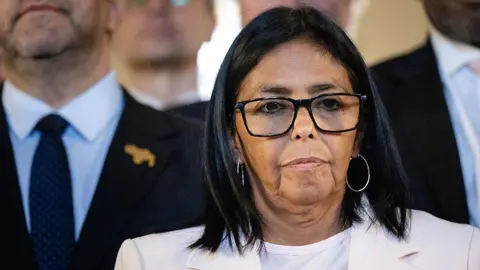
Some believe the US hopes to replicate the Venezeula model - where Delcy Rodriguez took over - in Havana
US could seek Havana leadership change
One possibility that US officials - including Trump - have floated is that new leadership could take over in Havana.
This playbook, experts have noted, could be similar to Maduro's replacement with Delcy Rodriguez in Venezuela, which left the government largely intact, albeit dealing directly with the Trump administration.
Trump has repeatedly said he is already dealing with figures inside Cuba who hope for US help amid worsening economic woes.
"Cuba is asking for help, and we are going to talk," he wrote on Truth Social on 12 May.
Days later, CIA Director John Ratcliffe met Cuban officials, including Castro's grandson, Raúl Guillermo Rodríguez Castro, and Interior Minister Lázaro Álvarez Casas.
"We'll engage with the Cubans... at the end of the day they need to make a decision. Their system just doesn't work," Secretary of State Marco Rubio told reporters in Florida on Thursday, adding that the administration's preference is a "negotiated agreement".
The changes that the US wants could include a pledge to open up the economy, invite more foreign investment and involvement by Cuban exile groups, as well as a commitment to end the presence of Russian or Chinese intelligence agencies on the island.
Importantly, these changes could leave Cuba's government largely intact.
"Just like they wanted to avoid instability in Venezuela, they want to avoid instability in Cuba," said Michael Shifter, a professor of Latin American studies at Georgetown University and the former head of the Washington-based Inter-American Dialogue, a think tank.
"Forcing a regime change would be too risky for that," he added.
Several experts contacted by the BBC said that the challenge for the Trump administration is that there is no immediately obvious figure waiting in the wings inside Cuba.
"I don't think there's an obvious Delcy Rodriguez in Cuba, and power works differently in Cuba than in Venezuela," Shifter said. "It's hard to find what they're looking for, but I do think they're looking for some sort of governing structure."
A third possibility is that Cuba buckles under the weight of the massive economic pressure it is facing, which has already led to hours-long daily blackouts and massive food shortages on the island.
"There will be no escalation. I don't think it's necessary," Trump said this week. "The place is falling apart. It's a disaster, and they have lost control to some extent."
Experts, however, paint a far more complicated picture in which the mechanisms of Cuban government control over its populace remain largely intact, even during a difficult economic period.
"You have to distinguish between the Cuban economy and the Cuban state and government," Shifter said. "The Cuban economy can collapse, and is collapsing... but the state still functions, especially on the security side."
Any state collapse could also pose a challenge to the Trump administration if large numbers of Cubans fled the country, particularly towards the US.
More recent Cuban arrivals have not been spared from a lack of access to political asylum and other immigration restrictions during the Trump administration.
"If there's a collapse, you're going to see a big portion of the Cuban population do everything they can to get away, the same way they have from Haiti over the years," Isacson said.
"Florida is the closest place, but I would also expect to see some people make their way to Mexico."
Isacson added that he was "surprised" such an outflux had not already begun.
"People are probably subsisting on 1,000 or 1,500 calories a day, and are not able to get basic healthcare," he said. "You'd think that people would already be building their boats."



 English (US) ·