
 2 months ago
68
2 months ago
68
ARTICLE AD BOX
1 hour ago
Soutik BiswasIndia correspondent

 LightRocket via Getty Images
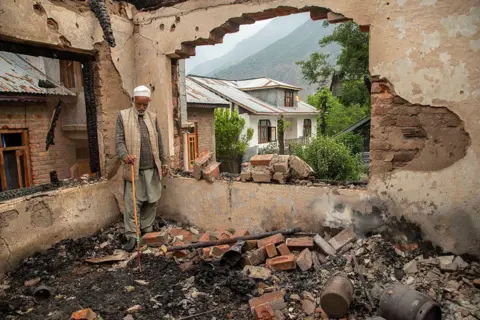
A man in Indian-administered Kashmir surveys his home damaged by cross-border shelling near the Line of Control during the 2025 conflict
A year after the four-day India-Pakistan conflict brought South Asia to the edge of a dangerous escalation, the region has drifted into a brittle and deeply uneasy equilibrium.
But the conflict hardened political and diplomatic estrangement, leaving little space even for limited normalisation.
Formal diplomacy is almost non-existent now. The border is shut, trade is suspended, cricket ties remain severed and the Indus Waters Treaty remains in abeyance.
"Relations remain in deep freeze," former Pakistani diplomat, Husain Haqqani, now a senior fellow at Anwar Gargash Diplomatic Academy and Hudson Institute, told the BBC. "Neither side believes it needs to reach out to the other for either domestic or international reasons.
"There have been moments of poor relations in peacetime before too, but this is one of the longest periods of frozen ties," says Haqqani.
Its aftershocks have spread far beyond the Line of Control (LoC) - the volatile de facto border that separates the two nuclear-armed neighbours.
"The conflict meaningfully altered outside impressions of the regional balance," says Daniel Markey of the Johns Hopkins School of Advanced International Studies.
"Before May 2025, many outside observers believed that India enjoyed an overwhelming advantage against Pakistan. Many Indians believed the same.
"Pakistan's ability to weather the initial Indian onslaught played to its strategic advantage, even though it is less clear what would have happened if the conflict had continued," Markey told the BBC.
 AFP via Getty Images
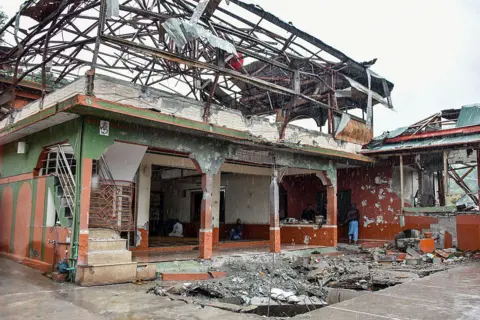
A mosque damaged by Indian air strikes in Pakistan-administered Kashmir during the conflict
Most strikingly, the conflict seems to have restored something Pakistan had long lost: geopolitical relevance. Its emergence as an intermediary in the Iran war caught many by surprise.
"Pakistan has rebuilt relevance," says Christopher Clary, a security affairs expert at the University at Albany.
"Pakistani leaders are conducting shuttle diplomacy throughout the Middle East. The question is whether it is transitory and merely the product of the US president's idiosyncratic preferences."
The revival has unfolded amid wider geopolitical churn.
Donald Trump repeatedly claimed credit for brokering the India-Pakistan ceasefire and offered to mediate on Kashmir - a disputed region claimed by both countries. The remarks irritated Delhi, which has long rejected third-party mediation, and contributed to strains in India-US ties.
Clary notes that Trump's "apparent affection" for Pakistan's army chief, now Field Marshal Asim Munir, significantly shaped the post-conflict environment.
"The US president has strong impulses that are not always easy to explain in terms of grand strategy," Clary says. "His desire to be seen as a peacemaker affected how he handled the May 2025 conflict."
Michael Kugelman of The Atlantic Council think-tank says Trump appears to see Pakistan's wartime performance as a "David-versus-Goliath story" - helping explain, at least partly, "his admiration for Munir".
At the same time, Pakistan used the Iran crisis and Gulf tensions to position itself as a useful intermediary between Washington, Tehran and Arab capitals.
Yet, analysts caution against overstating Pakistan's gains.
Much of Islamabad's renewed prominence may prove contingent on Trump's highly personalised style of diplomacy and the temporary strategic importance of the Iran crisis.
"This is also a gamble for Munir," says Markey. "The shifting sands of Middle East politics are a dangerous game, and working with the Trump administration often brings surprises."
 AFP via Getty Images
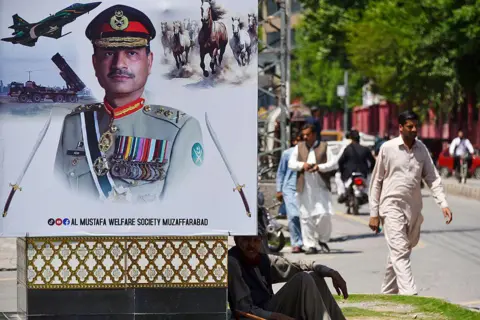
A man sits beside a poster featuring Asim Munir, now chief of defence forces, in Pakistan-administered Kashmir
Even so, the conflict unsettled India's diplomatic assumptions.
For years, Delhi believed its strategic partnership with Washington had transformed the regional equation. But Trump's public embrace of Pakistan, repeated mediation claims and trade tensions with India injected new unpredictability into the relationship.
"The credibility of the US established since Kargil [the 1999 conflict between India and Pakistan] as a reliable interlocutor during crises has considerably gone down," says Ajay Bisaria, India's former high commissioner to Pakistan.
Clary argues the deterioration in ties accelerated a broader recalibration already under way in Delhi.
"Since May 2025, and reinforced by the subsequent US-India mini-trade war, India has rebalanced its global portfolio of relationships to be somewhat less dependent on the US," he says.
That has involved "moving closer to the European Union, accelerating diplomatic repairs with China, and resisting American pressure to sever ties with Russia".
Still, India's larger strategic trajectory remains intact. "India is a big enough power," Clary says, "that disequilibrium does not imperil its continued rise."
 NurPhoto via Getty Images
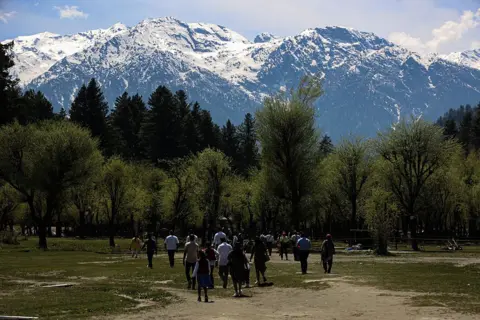
Tourists return to Pahalgam, where the militant attack that triggered the conflict took place
If the diplomatic consequences remain contested, the military lessons are clearer.
Analysts on both sides describe the conflict as South Asia's first truly networked, drone-heavy, high-tech clash.
"What we saw was a technologically different battlefield," says Bisaria. "No manned aircraft crossed the border."
Both countries have upped defence spending, accelerated military modernisation and deepened ties with foreign defence partners since then.
But Clary cautions against assuming the conflict fundamentally altered the regional balance of power.
"It caused important organisational, doctrinal and technological shifts in both militaries," he says, "but I do not believe either military has substantially changed its thinking about the relative balance of power between it and its neighboring foe."
What may have changed instead is the threshold for future escalation.
Bisaria describes the post-conflict environment as "a new normal with some degree of strategic ambiguity".
"That ambiguity tells you that every act of terrorism will be an act of war," he says. "This will resume if there's any more terrorism over a certain threshold." (Delhi blamed the attack on tourists on Pakistan-based militant groups - an allegation Islamabad denied.)
 NurPhoto via Getty Images
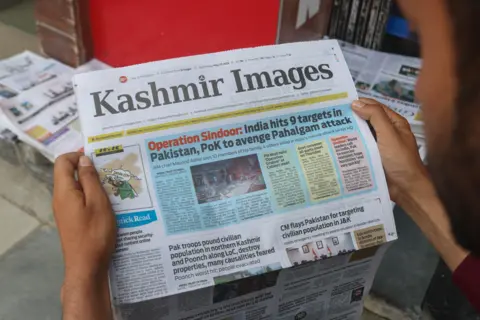
The conflict lasted barely 90 hours before the ceasefire was announced
India's signalling after the conflict suggested future retaliation may extend beyond militant groups to the Pakistani military itself. "Terrorists and their backers will be treated the same way," Bisaria says, echoing the Indian government's position.
The suspension of the Indus Waters Treaty has become another marker of this harder posture.
"Blood and water can't go together," Bisaria says. "There is no way the treaty is coming back."
From Pakistan's perspective, however, the conflict appears to have reinforced faith in its own escalation strategy.
Haqqani argues the brief duration of the conflict worked to Pakistan's advantage.
"Pakistan's strategy has been to move rapidly up the escalation ladder so that the threat of nuclear war brings in the international community," he says.
That belief appears widespread within Pakistan's strategic community.
Umer Farooq, an Islamabad-based analyst and a former correspondent of Jane's Defence Weekly, says there is growing confidence in Islamabad that Washington and Gulf capitals would intervene rapidly in any future crisis.
"In Pakistan, there is a belief that Americans have forced Pakistan and India to the negotiating table before and they can do it again," he told the BBC.
At the same time, he says, Pakistan's military and political elite appear acutely conscious of the country's internal fragility.
"Our economy is in a shambles, society is deeply divided, we are facing two insurgencies," Farooq says. "There is a mainstream thinking in the political and military elite that we should not go for any conflict with India."
That tension - between deterrent confidence and economic vulnerability - may explain the carefully calibrated signals emerging from Rawalpindi in recent months.
 AFP via Getty Images
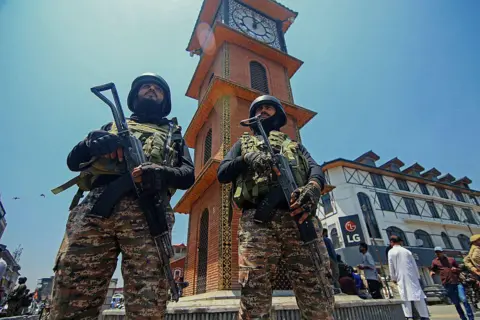
Patrolling Indian soldiers in Indian-administered Kashmir in May 2025
Without naming India directly, Pakistan's corps commanders recently stressed the need for "restraint and avoidance of escalation", saying regional stability depends on "collective restraint, responsibility and respect for sovereignty".
This statement, says Farooq, is a "continuation of what has already existed in the military - dialogue should continue".
Even now, few believe the two sides can afford a complete diplomatic freeze indefinitely.
"The two countries have a long history of backchannel dialogues," Markey notes, "and these have at times been effective ways to mitigate hostility and even to set the stage for more formal dialogues."
Bisaria also sees "a ray of hope" if the region avoids another major militant attack.
He says Pakistan may eventually see merit "not in normalising but stabilising the India front".
Kugelman argues that, for now, "the best possible outcome is that things don't get any worse".
Ultimately, the future may depend less on geopolitics than on the calculations of two powerful leaders: Narendra Modi and Asim Munir.
"Field Marshal Munir and Prime Minister Modi have incredible sway in their respective capitals," Clary says. "They have it within their power to renew diplomacy if either man desired it."
For now, neither appears ready.






 English (US) ·