
 3 months ago
86
3 months ago
86
ARTICLE AD BOX
Marie-Louise ConnollyHealth correspondent, BBC News NI

 BBC
BBC
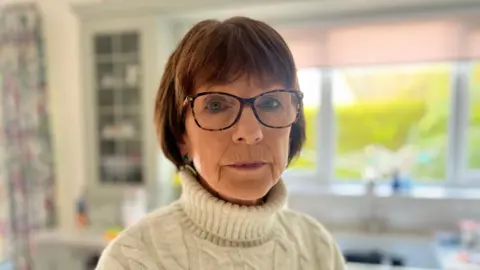
Jo-Ann Burns says Nicola was a daughter and a best friend
A woman whose daughter died from a condition linked to epilepsy has said the family feels "robbed" and "heartbroken".
Nicola Burns was 41 years old when she died in her sleep from a condition called Sudden Unexpected Death in Epilepsy (SUDEP).
Her mother Jo-Ann Burns has said Nicola was not told about SUDEP, despite having lived with epilepsy for years.
She has told BBC News NI that epilepsy patients need to be warned they are at a higher risk of death and what they can do to reduce it.
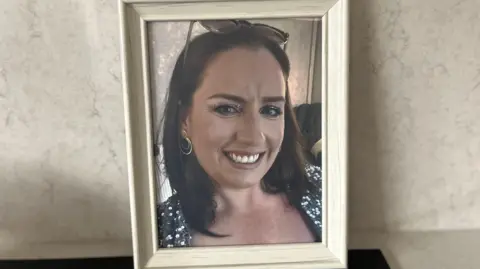
Nicola Burns died in May 2025
SUDEP has several warning signs, including uncontrolled and nocturnal sleep seizures, and affects about one in 1,000 people with epilepsy every year.
Nicola had not shown any signs of illness as a child but was diagnosed with nocturnal seizures in her 20s.
Even after her diagnosis she did not show many signs of the condition, only rarely going to hospital after a seizure.
Jo-Ann said because of this they had become "too complacent" about the illness and the family would have been more wary if they had been made aware of the risk of SUDEP.
"We feel robbed. Nicola was handling her epilepsy, taking her medication which was reviewed periodically but she nor us knew anything about sudden unexpected death."
Because SUDEP is thought to happen either during or following a seizure, it is possible that it is due to a problem with the person's heart, or breathing, during or following the seizure.
Symptoms of nocturnal seizures can include signs of sudden awakening with confusion, thrashing, violent movements, screaming, or waking up on the floor.
While most pass without complication, they can lead to injury or, in rare cases, death.
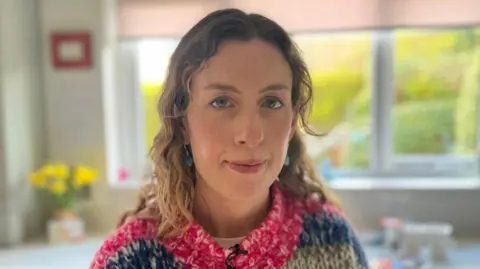
Catriona Burns wants more people to know about SUDEP, and to be aware of the risks even if they are feeling well
Nicola's sister Catriona said the death feels like a nightmare that they have still to wake up from.
"I loved her to bits, she was my big sister who did everything for all of us."
She said it came even more as a shock as epilepsy was always just in the background of her sister's life.
"We probably underestimated it because Nicola lived life to the full and was rarely ill, in fact I never witnessed an epileptic fit.
"I spoke to her the night before she died and we laughed about her having a cocktail. She sent me pictures and was just in great form on a work event in London."
Catriona said the situation was "made worse" as she felt it "could have been prevented, if we'd known about the condition".
At an inquest into Nicola's death in 2025, the coroner queried why SUDEP had not been raised with her and why an annual review by the South Eastern Health Trust had not taken place.
In correspondence to the family, seen by the BBC, the trust said Nicola's annual review did not take place due to "capacity" issues.
In a statement to BBC News NI the trust said it wished to express its "deepest condolences" to the family and that following a review, an advice document had been created for patients which includes a section on SUDEP.
The family have described the South Eastern Health Trust's response to their daughter's death as "disappointing".
The family also said they were told that SUDEP is normally discussed at the time of diagnosis and, as this had happened while Nicola lived in England, the responsibility lay there.
The Walton Centre in Liverpool, where she was diagnosed, confirmed there was "no written confirmation" that SUDEP had been raised with Nicola.
In a letter it said: "It is therefore not clear whether this was discussed with her and not documented but we have not clearly documented this."
Jo-Ann said the family has been left wondering would the outcome have been different if Nicola had been reviewed as planned.
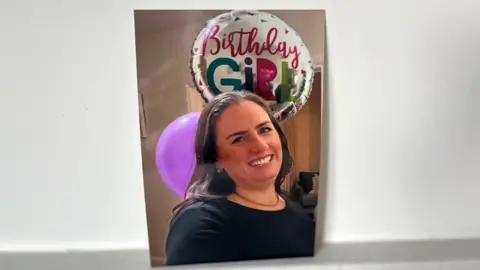
The family is speaking out so other families don't have to live through similar pain
Nicola's death prompted the family to reach out to the charity SUDEP Action and they discovered many families like theirs had not heard of the condition until after their loved ones died.
The charity's Jane Hanna said patients and their families need to be armed with information as deaths can be prevented with more awareness.
"Epilepsy is a cliff edge condition. While some people may seem really well, if their epilepsy is out of kilter, there is this risk of sudden death," she said.
The charity has several tools to support patients and clinicians including a digital app and a checklist, so patients can track their symptoms, know what their personal risks are and lower them.
The National Institute for Health and Care Excellence (NICE), said clinicians should discuss the risk of SUDEP with people who have seizures during sleep and, if appropriate, to include their families and carers.
Management includes treatment involving anti-seizure medications (ASM), keeping a consistent sleep schedule, and using seizure monitors.




 English (US) ·