
 3 months ago
79
3 months ago
79
ARTICLE AD BOX

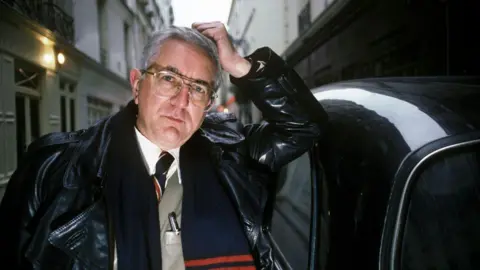 Getty Images
Len Deighton, who has died at the age of 97, was one of the masters of 20th century spy fiction.
A talented illustrator, he began writing purely to pass the time and never expected to get published.
Unlike James Bond, Deighton's secret agents were ordinary working-class people, often frustrated by the incompetence of their own side.
A self-effacing man, the author was also a skilled chef who published a number of best-selling cookery books.
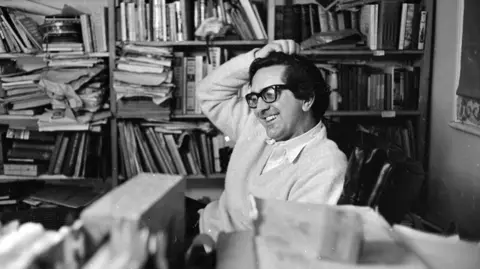 Getty Images
Len Deighton photographed in 1966, a year after he had written The IPCRESS file
Leonard Cyril Deighton was born in Marylebone, London on 18 February 1929. He came into the world in the sick bay for a workhouse, as the local hospital was full.
His parents worked for a wealthy family, his mother as a cook and his father as a chauffeur.
In 1940, he saw his mother's client - Anna Wolkoff - dragged off by the British Security Services and accused of being a wartime Nazi spy.
"It was a major factor in my decision to write a spy story at my first attempt at fiction," the author later recalled.
He hated school and his exasperated father told him that he would stop punishing him for bad reports if he applied himself to reading.
The young Len still played truant but took himself down to the local library where he would often read all day.
"A terrible kind of sedentary childhood I had, when I think about it," he said.
He did his National Service in the RAF - where he learned spy skills including photography, flying and scuba-diving - before working for brief periods as a railway clerk and an air steward.
After a spell as a press photographer, he studied at the Royal College of Art and began a successful career as a book illustrator.
A lover of good food, he wrote and illustrated a cartoon cookery strip for the Daily Express, which transferred to The Observer in 1962.
These strips were later collected in the Len Deighton Action Cookbook which, together with a companion book, Ou Est le Garlic (Where is the Garlic), was aimed at London's young singles, living away from home for the first time.
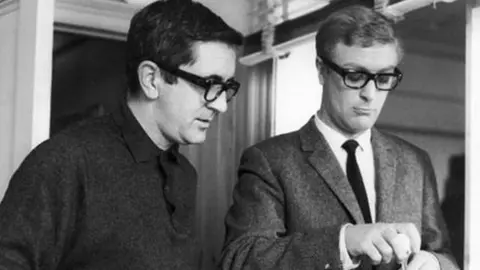 Michael Ochs Archive via Getty Images
Deighton took a keen interest in the filming of The Ipcress File. In this photo, Deighton is giving Michael Caine a lesson in cooking omlettes
It was while he was on holiday that he started a story about a secret agent which would eventually become The IPCRESS File, although he had no thought at the time of publication.
However, the first Bond film, Dr No, had just been released, awakening interest in the spy genre and a literary agent sold Deighton's story to a publisher.
"It might have sunk without a ripple," Deighton later recalled, "but it did very well, because the critics used me as a blunt instrument to beat Ian Fleming over the head."
Shortly afterwards the Bond film producer, Harry Saltzman, bought the film rights to the IPCRESS File and Deighton was suddenly famous.
The hero was never named in the book, but the character was christened Harry Palmer for the film and played by Michael Caine.
The character was the complete antithesis to Bond.
007's exotic locations were replaced by the grey and grubby backstreets of 1960s London for The Ipcress File (for some reason, the film-makers did not like Deighton's capital letters).
And - unlike Bond - Harry Palmer was working class. This was a decision influenced by the board of an advertising agency on which Deighton had once served, where everyone else went to Eton.
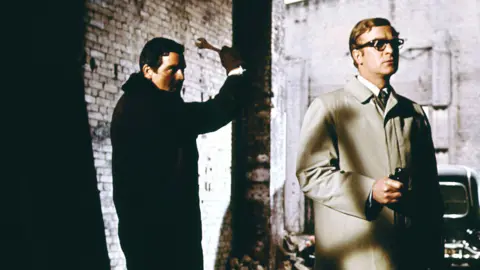 Getty Images
Michael Caine playing Len Deighton's Harry Palmer in Funeral in Berlin
Palmer found himself spending time trying to get his expenses cleared through an incompetent bureaucracy, rather than romancing a beautiful girl on a sandy beach.
But Deighton insisted the his character was no anti-hero and he was not going to pepper his books with violence, as Fleming had done.
"When I started writing I had rules," he said. "One was that violence must not solve the problem, and I cannot have the hero overcome violence with a counterweight of violence."
Deighton took a keen interest in the filming and was often on set, where he and Caine became great friends.
In the scene where Michael Caine is making omelettes in the kitchen, it is Deighton's hands which break the two eggs simultaneously as the actor was unable to get the hang of it.
The character appeared in four further books, Horse Under Water, Funeral in Berlin, Billion Dollar Brain and An Expensive Way to Die.
Funeral in Berlin - which stayed on the New York Times best seller list for six months - and Billion Dollar Brain were also filmed for the big screen, again with Michael Caine in the leading role.
An Expensive Way to Die was serialised in Playboy, for whom Deighton had become a travel writer.
His success made him part of an exciting arts scene in the 1960s and his cookery skills often saw him hosting dinner parties for celebrities.
In 1969, he co-produced and wrote the screenplay for the film adaptation of the satirical musical, Oh! What a Lovely War.
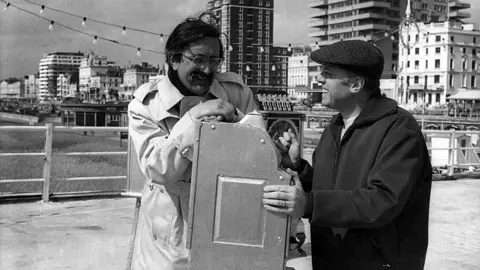 Getty Images
Len Deighton and Richard Attenborough photographed during filming for Oh! What A Lovely War
He persuaded actor Richard Attenborough to make his directorial debut on the film.
But an attempt - over a curry at Deighton's house - to persuade Paul McCartney into taking a lead role came to nothing.
Ultimately, he was unhappy with the way the film turned out and insisted his name was removed from the credits, something he later described as a childish decision.
He did, however, endear himself to the film crew when he successfully hot-wired a number of cars parked in a street that needed to be cleared for filming.
In 1969, Deighton wrote Bomber, the story of an RAF raid over Germany, which is often hailed as one of the great anti-war novels.
Deighton tells the story through the eyes of the protagonists on both sides including the RAF bomber crews, the German fighter pilots and the townspeople caught up in the raid.
The book, published just a quarter of a century after the events that inspired it, caused consternation because of the way it highlighted the suffering of German civilians.
Kingsley Amis listed it as one of the 99 greatest novels since 1939, and the BBC later broadcast a real-time dramatisation of the story on Radio 4 to mark the 50th anniversary of the end of World War Two.
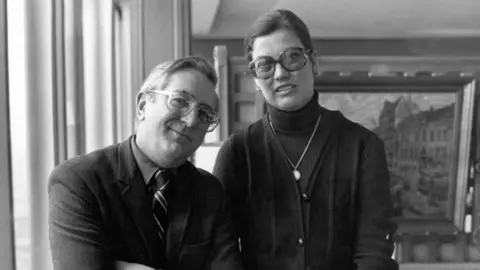 Getty Images
Len Deighton and his second wife, Ysabele, photographed in 1984
Deighton went onto write more books based on the 20th century's most deadly conflict.
In 1977, he published Fighter - a non-fictional account of the Battle of Britain, which Hitler's former armaments minister, Albert Speer, described as "excellent".
A year later, SS-GB envisaged what might have happened if Germany had won the Battle of Britain - beating Robert Harris to the concept of an alternative history novel by 20 years.
In the 1980s, Deighton published Berlin Game, featuring a new character, Bernard Samson.
Like the character in his earlier spy novels, there is little glamour in the life of the jaded and cynical Samson, who has a healthy disregard for his bosses.
The novel was the first of three Samson trilogies that Deighton produced between 1983 and 1996.
Granada Television produced a lavish 12-part adaptation of the first trilogy, entitled Game, Set and Match. But it was poorly received and Deighton did not permit it to be shown again.
After completing Faith, Hope and Charity in 1996, Deighton decided to take a year off, but he never resumed his literary career.
In a 2006 interview with BBC Radio 4, he told Patrick Humphries that he had come to the conclusion that writing was "a mug's game" and he didn't miss it.
Instead, he moved to Ireland with his second wife, Ysabele, and their two sons. They later divided their time between homes in Portugal and Guernsey, with Deighton confirming his retirement in 2016.
His spy novels slipped from the public consciousness in those years, in contrast to Fleming's James Bond, which benefited from the marketing juggernaut of a continuing film franchise.
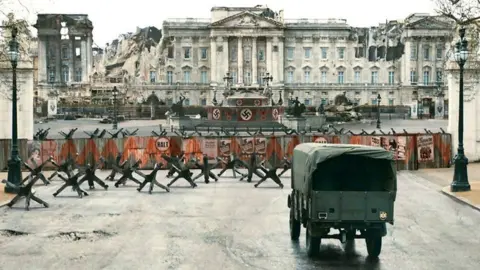
Len Deighton's SS-GB imagined what would have happened if Germany had won WWII
However, there was a revival of interest when, in 2017, the BBC screened a dramatisation of SS-GB, nearly 40 years after the publication of the novel on which it was based.
And, in 2022, The IPCRESS file - the book that started it all - was remade for ITV, starring Joe Cole, Lucy Boynton and Tom Hollander.
Deighton rarely gave interviews and never considered himself a natural writer.
"The best thing about writing books, he said on the BBC's Desert Island Discs programme, "is being at a party and telling some pretty girl you write books.
"The worst thing is sitting at a typewriter and actually writing the book."
But, from time to time, he said, being an author has its advantages.
"When you make a book," he once said, "it's like making a hand grenade. It's a dull process but when you throw it the person at the other end gets the effect."





 English (US) ·