
 2 months ago
56
2 months ago
56
ARTICLE AD BOX
8 minutes ago
Sir John CurticeProfessor of politics, Strathclyde University

 BBC
BBC
The overnight local election results have confirmed that, for the time being at least, electoral politics in Britain has become highly fragmented.
Reform are certainly the winners. The party has won most seats - 30% of those declared so far.
Meanwhile in a sample of over 500 wards where the BBC has collected the detailed voting figures, the party has recorded an average vote share of 26% - not an especially high figure but still enough to put them well ahead of all of their rivals.
Nigel Farage's party has done best in places that voted heavily for Brexit in 2016. In wards where more than 60% voted for Leave in 2015, support for Reform has averaged 41%.
In contrast, in places where less than 49% backed Brexit, Reform won on average just 10%. The one place where it has gained control of a council, Newcastle-under-Lyme, voted by nearly two-to-one in favour of Brexit.
The Greens' success was more modest. They have averaged 16% of the vote in the wards declared so far, much as we would anticipate from their standing in the polls.
Nevertheless, this represents a seven-point increase on the party's support when this round of local elections was last held in 2022 - and on its performance in the local elections held shortly before the 2024 general election.
This suggests the Greens are heading for their best local election performance ever. However, so far at least, the party has yielded a net gain of just 25 seats. The party has secured a number of creditable second and (especially) third places, but relatively few firsts.
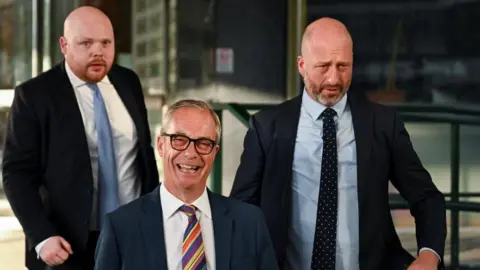 Reuters
Nigel Farage's party is the clear winner so far
In contrast, both Labour and the Conservatives have suffered a sharp loss of support.
On average, Labour's vote is down by 16 points on that in 2022 - and even more - by 19 points compared with 2024. The drop has been especially sharp in places where the party was previously strongest and in wards where many people identify as Muslim.
This pattern has helped to magnify the party's seat losses, which currently stand at 250 seats or half of all those it has been trying to defend. So far the party has lost control of eight councils.
Meanwhile, support for the Conservatives is down on average by 11 points since 2022 and 9 points since 2024 (by which point the party had already lost much of its former popularity).
Support fell especially heavily where Reform support was highest, underlining the threat it is posing to Kemi Badenoch's party.
So far it has suffered a net loss of 137 seats, a figure that, as in Labour's case, has been magnified by the fact that its losses have been greatest in places where it was previously strongest.
The party has had one bright spot - regaining control of Westminster, once a highly prized jewel in the party's London crown that was taken from its grasp by Labour in 2022.
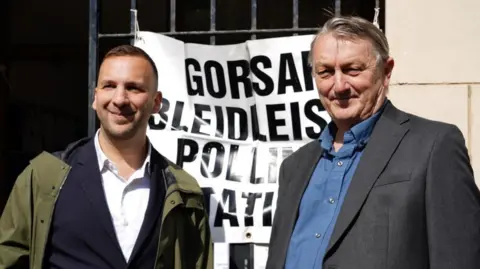 PA
PA
Green Party leader Zack Polanski was in Wales on election day on Thursday
However, their success was a reflection of a sharp 17-point fall in Labour support rather than an indication of any progress made by the party itself - its own tally too fell by five points, in what is now one of the few places that is still primarily a Conservative vs Labour battleground.
The Liberal Democrats anticipated making significant gains. However, so far they have not really transpired.
The party gained control of Portsmouth and Stockport but lost control of Hull. On average support for the party is down by three points on both 2022 and 2024.
It has gained seats primarily because in places where it started off in second place it has been able to profit from the sharp falls in Conservative or Labour support. There is little sign of the party being able to make the kind of electoral progress that has been registered by Reform or even the Greens.
Still, so far the results have only been declared for one-in-three of the seats being contested. The outcome of many key battles is as yet unknown. Both the Conservatives and Labour will be hoping that today brings them better news.
Analysis by Patrick English, Steve Fisher, Robert Ford, Lotte Hargrave, Johnathon Mellon and Stuart Perrett.


 English (US) ·