
 1 month ago
61
1 month ago
61
ARTICLE AD BOX

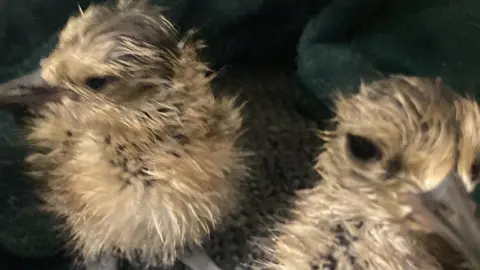 Sliabh Beagh Curlew Conservation Trust and RSPB
Two of the four chicks which came from the eggs saved in the wildfire
It's been a happy ending for the eggs of an elusive bird that were just inches from the flames of a large wildfire earlier this year.
Saved by firefighters during the blaze in Brookeborough, County Fermanagh, the four curlew eggs have now hatched.
The chicks will eventually be released into the wild, and conservationists are delighted.
The curlew was once a common sight, but numbers have fallen in recent years and there are now thought to be just 150 breeding pairs of curlews left in Northern Ireland.
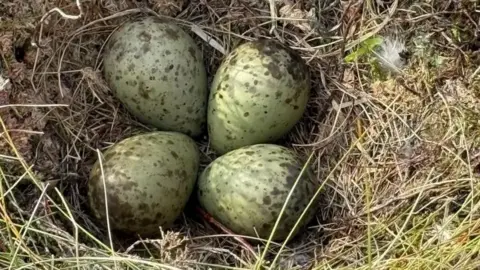 NIFRS
NIFRS
During a wildfire in County Fermanagh earlier this year a curlew nest was found in the fire's path
Róisín Normanly of the Royal Society for the Protection of Birds (RSPB) told BBC News NI that the curlew nest had been fenced off to protect it - but within 24 hours a wildfire had broken out.
At its height, 85 firefighters battled the blaze but despite challenging conditions, they were able to protect the nest.
Normanly said the fire crews "kept the fire back while we got into the eggs".
She said: "The fire was about a metre from the nest when we got there, so it was really close to the bone.
"But we got there just in time."
The Northern Ireland Fire and Rescue Service (NIFRS) said it worked with the RSPB and the eggs were "safely removed for incubation" so they had "a chance of survival".
A host of agencies was involved in the conservation effort including the Forest Service, Conservation Detection Dogs NI and the Sliabh Beagh Curlew Conservation Trust.
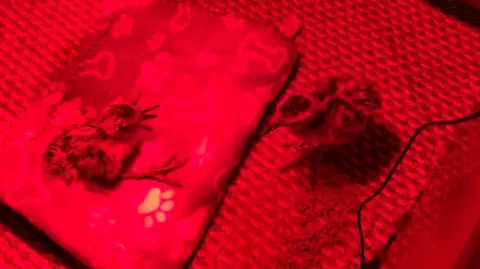 Sliabh Beagh Curlew Conservation Trust and RSPB
The chicks are just over a week old as this infrared camera shows
Normanly explained that the eggs "were collected very carefully, wrapped up individually and packaged into a biscuit tin" to be transported to the incubation facility.
Chairman of the Sliabh Beagh Curlew Conservation Trust Dr John Cusack said the eggs were incubated for just under four weeks.
"All four [chicks] are happy and healthy and thriving and we're delighted about that," he said.
"We're going to release them and hopefully they'll do well after they are released back into the wild.
"Ideally, you want them to spend time with their parents, to be reared by their parents and learn the skills necessary. But it is still a very, very big deal."
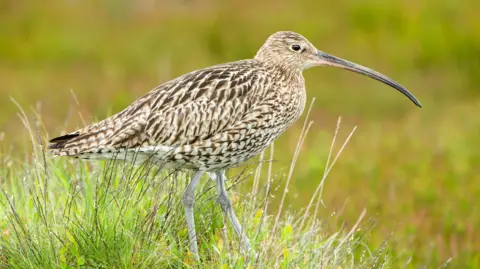 Getty Images
Curlews can live for up to 30 years
Normanly said the chicks are still "quite vulnerable" but when they are about three weeks old, they will be moved to bird pens.
And once they can fly and look after themselves, the RSPB plans to release them fairly close to where they came from.
Dr Caroline Finlay, Director of Conservation at Detection Dogs NI, said there were "birds who've been raised in captivity before, now nesting on Sliabh Beagh successfully, which is absolutely fantastic".
"It's not a common thing, but it's great to see that this is possible.
"These chicks can go on and have their own nests and their own eggs and own babies eventually, so it's a great story," Finlay said.
What should you do if you spot a curlew?
These birds are perfectly camouflaged, said Finlay, meaning you can be standing a couple of metres beside one and miss it.
He urged people who do manage to spot them not to disturb the birds or the nest but to contact the RSPB or the Sliabh Beagh Curlew Conservation Trust.
Finlay also urged people to keep dogs on their lead.
Speaking about that find, the trust said: "For a species that has declined by over 98% in Ireland since the 1980s, this is a genuinely significant and hopeful conservation milestone."


 English (US) ·