
 3 months ago
73
3 months ago
73
ARTICLE AD BOX
Katy Watson, Australia correspondent, and Simon AtkinsonReporting from the Gold Coast

 Getty Images
The Iranian women's football team before their Asian Cup match against Australia
The first hint something was up, was when we spotted a small group of Iranian footballers in the hotel lobby.
We counted at least three players, wearing black headscarves and dressed in the team's grey shirts, chatting with four people we suspected at the time - and now know - were Iranians from the local community here on Australia's Gold Coast.
What stood out at the time was the ease with which they were talking together. They were casual, smiley, sometimes laughing. They looked comfortable.
How was this possible? Much had been said about the 26-member squad being watched, not given access to the internet, unable to talk to anyone outside their group. So that was our biggest question mark. Where was their minder?
Concerns about the team's safety were first sparked when footage of a state TV host emerged calling them "traitors" who ought to be punished after they declined to sing the national anthem at their first AFC Women's Asian Cup match last week.
Those worries only grew after the team were seen singing the anthem in their two subsequent matches. The implication was they felt pressure - direct or otherwise - to do so.
After their elimination from the tournament on Sunday and the prospect of their imminent return to Iran, the media debate also focused on what repercussions their families might face if they chose to stay.
A network of Australia-based activists meanwhile kicked into gear, using their contacts to try and communicate with the players in any way possible.
"Our community in Queensland did whatever we could," Iranian human rights activist Hesam Orouji told the BBC.
He was one of the four people from the Queensland Iranian diaspora we had seen in the hotel lobby talking to players at around 5.30pm on Monday afternoon.
Earlier in the day, members of the team had come and gone. There was a small group who had gone for a walk around the resort's vast gardens - and the football pitches which teams staying here had used for practice. But they kept to themselves. That was what we had expected. This gathering that was playing out in front of us was different.
A hotel security guard in a blue shirt also joined the group. They talked some more, before the group sauntered casually towards the lobby's automatic doors.
Outside, stood several uniformed Australian Federal Police officers. But there had been a police presence all day. It was all so low-key, we assumed the group was going for a bit of fresh air - like their colleagues had done earlier.
Less than half an hour later - two members of the Iranian delegation sprinted across the lobby, and down a stairwell leading to the basement carpark. A player and coach Marziyeh Jafari followed them.
The sudden movement in an otherwise tranquil foyer was striking. We followed, filming on phones. The timestamp shows this was 6.08pm local time.
The door at the bottom of the stairs was locked, so the Iranians retreated, looking stressed.
The women - we now know it was five of them - had gone.
It was a discovery made bang on sunset - just as the team was likely getting together for iftar - the traditional meal to break the fast during Ramadan.
Perhaps it was the players not joining them that had alerted them to their escape.
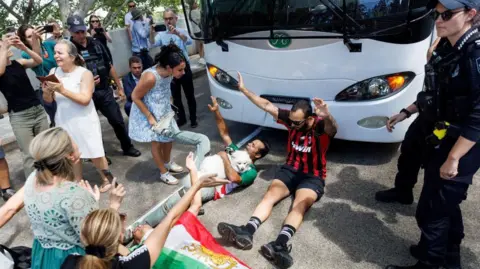 Reuters
Protesters lie in front of the coach carrying the Iranian team from the Gold Coast hotel where they were staying
What we know now is that the scene witnessed was the result of a long and complicated process which led to five Iranian players seeking asylum.
Within hours, Fatemeh Pasandideh, Zahra Ghanbari, Zahra Sarbali, Atefeh Ramazanzadeh, and Mona Hamoudi had been granted humanitarian visas.
Later two more people - player Mohaddeseh Zolfi and support staff member Zahra Soltan Meshkeh Kar - also indicated they wanted to remain in Australia. At some point on Tuesday, they were separated from the rest of the squad at the Gold Coast hotel and taken to a police base near Brisbane airport.
They were reunited with the other five - all seven had been promised they would be able to stay permanently here - but then on Wednesday, one woman changed her mind.
"In Australia people are able to change their mind. We respect the context in which she had made that decision," Immigration Minister Tony Burke told parliament on Wednesday.
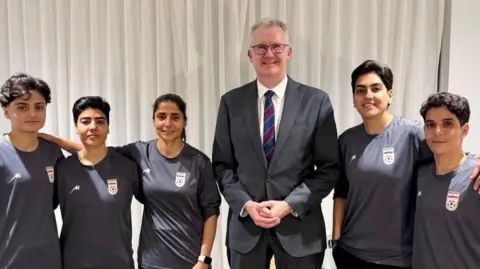 Reuters/Australian Department of Home Affairs
Australian Home Affairs Minister Tony Burke with five players granted humanitarian visas
Trying to establish contact
Before all this played out, activists had been liaising with Australian Federal Police and hotel security to ensure that the women were first able to confide that they wanted to remain in Australia, and secondly that when they did so, they would be protected.
"We went to the stadium chanting [their] name, saying if you want to stay here, we are going to support you," Orouji said.
And that, said Orouji, was a game-changer for at least some of the women choosing to seek asylum.
"They mentioned that, they said it was great," he says. "It was the first time this big crowd came to the stadium and just supported us - there was lots of energy, motivation about what was going on in Australia."
The biggest challenge for Orouji and his friends has been giving the women correct information - and trying to counter misinformation spread by the Iranian regime who are reportedly accompanying the group.
"When we said to one of the [remaining members of the team], do you know the women already have their visas, they said no way!"
Some women, he said, had been told there was no guarantee they could seek asylum and may have to go to a detention centre instead, as a refugee.
Orouji made the initial connections with the players through a family member - but communicating with them wasn't straightforward.
"They don't have internet all the time," he explains. "We send a message, we can see they didn't receive the message, and then they get internet, and we count the two blue ticks on WhatsApp."
Every member of the Iranian community I spoke to seemed to be finding their own way of communicating with players - reaching out on social media, sending messages when they could.
There are more than 85,000 Iranians living in Australia. Many have formed a tight-knit community,
Also at the hotel on Monday evening was migration agent Melody Naghmeh Danai, on standby to assist those choosing to stay about their options. She'd been at the stadium on Sunday night, keen to show her support as many ways as possible.
"Australia is going to support them according to migration law - it's not anything which is extraordinary," she told the BBC during the halftime break. "We are very concerned for their lives, and we are here to support them any way they want."
On Monday afternoon, we saw her again at the hotel - dressed in a suit rather than the more casual football fan attire of the night before
We said hello - but what she couldn't reveal at the time was she had been given access to the players in a room at the hotel - using her knowledge of migration law and language skills to set out their options.
"They were under a lot of stress. They didn't know what to do, they were worried about their family, their assets in Iran, what is the best decision to make now: 'What if we stay here and we lose all our assets in Iran?'" Danai told ABC News.
While activists played a key part, more has emerged about the government's role. A Truth Social post by Donald Trump urging Australia to offer asylum to the players led some to suggest he was the impetus for swift action.
In fact delicate operations had been going for several days. Trump - after a 2am phone call to Anthony Albanese - followed up, saying of the prime minister: "He's on it!"
Immigration officials had sought to have meetings with the players at their hotel.
And though it was widely reported that players were confined to their rooms and were being constantly watched - this does not seem to have been the case.
Home Affairs Minister Tony Burke has talked of "very late night conversations" on Sunday evening after offers of a chat were made to the players.
"People then started to come down and talk in the foyer of the hotel. They were moving around, at least at that hour, without people watching them," he said.
"That's not to say that there wouldn't have been other conversations that were happening privately that we would all view as unacceptable."
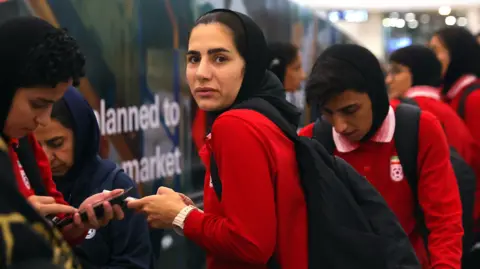 EPA
EPA
The remainder of the team at Malaysia's International Airport, as they made their way back to Iran
As those talks were happening, the activists were hard at work.
None of the community gave up, even as the remainder of the team headed to the airport to fly out of Australia on Tuesday night. At every airport there was a protest. At every protest, there were tears.
And it is increasingly clear that the Australian government was reinforcing this message.
Burke, who signed off on the first five players humanitarian visas in a matter of hours, was at Sydney airport before the squad left Australia late on Tuesday night.
Here - he said - a "very significant police presence" was used to make sure players were able to be kept separate from minders and meet with immigration staff along with an interpreter - and the opportunity to speak to family in Iran about what to do.
"They were given a choice," Burke said.
"We made sure of was was that there was no rushing. There was no pressure. Everything was about ensuring the dignity for those individuals to make a choice."


 English (US) ·