
 1 hour ago
5
1 hour ago
5
ARTICLE AD BOX
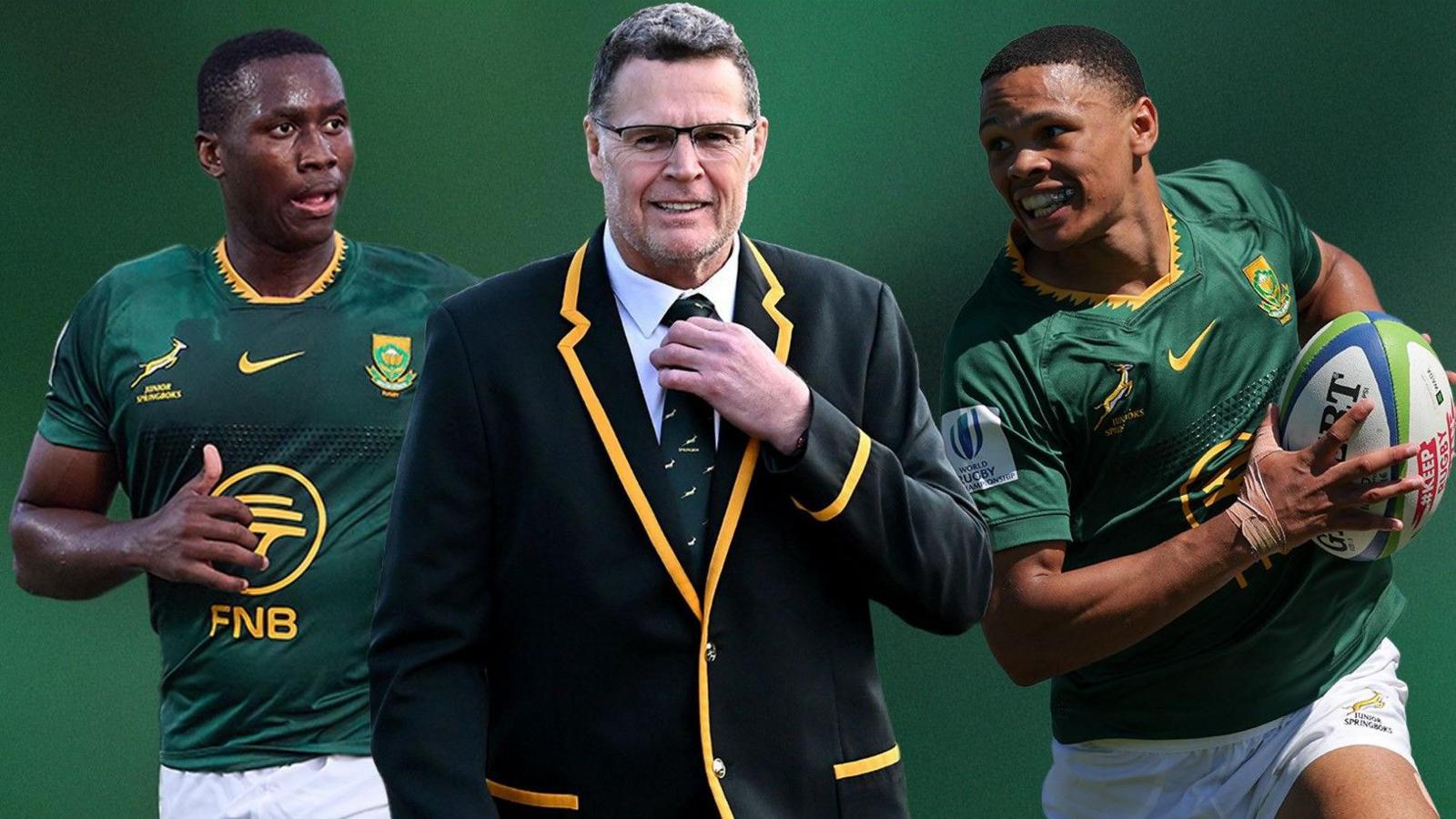 Image source, Getty Images
Rassie Erasmus is developing new talent as South Africa build up to their 2027 Rugby World Cup defence
ByGareth Rhys Owen
BBC Sport Wales
The Springboks' seemingly endless supply of talent is the envy of world rugby. So why does South Africa continue to produce world-class players at a rate few nations can match?
Every rugby nation wants what South Africa have: four World Cups.
World Cup winners have retired. Others have headed overseas.
Yet the Springboks never seem to run out of international-class players.
The latest is 20-year-old Sharks fly-half Vusi Moyo, who will start his first Test against Wales on Saturday in Durban having played just 58 minutes of senior rugby.
For many countries, it would represent a remarkable leap of faith. For South Africa, it is becoming increasingly familiar.
The obvious explanation is numbers. South Africa has one of the world's biggest rugby-playing populations. But that only scratches the surface.
To understand why the Springboks never seem to run out of players, you have to look far beyond the international team.
It is the simplest explanation and, perhaps, the least satisfying one.
South Africa has one of the world's largest rugby-playing populations. But those inside the game insist that is only the starting point.
"I think what helps first, obviously, is you need to have a high number of participation," says Rito Hlungwani, forwards coach at Cape Town-based United Rugby Championship (URC) side Stormers.
"I started playing rugby when the Springboks won the 1995 World Cup. Then if you look at it now, we've won two World Cups in a row, so that has increased participation across racial boundaries.
"That has really increased the number of kids playing rugby."
Participation alone, however, is not enough.
"What really drives it is the mentality," says Hlungwani.
"People always talk about the physicality of South African rugby players. Kids these days, that's all they want to be like. They want to be like the Springboks. They talk about physicality at the age of nine.
"It's pretty much what's in front of the windscreen that's driving participation. Kids are learning from their heroes."
Speaking on the Scrum V Podcast, former Springbok Hanyani Shimange says there are clear traits expected of anyone hoping to wear green and gold.
"If you want to be a Springbok you have to be defensively solid, have a high work-rate and a good power game," he said.
Hlungwani believes it is the mindset, the coaching and the competitiveness that transform promising youngsters into Springboks.
Where the production line begins
If participation provides the raw material, schools are where South Africa's production line truly begins.
"It's probably one of those countries that rivals New Zealand in terms of having rugby as some kind of religion," says South African rugby writer Simnikiwe Xabanisa.
"The schools, that's the rugby pipeline.
"Our schools rugby is televised much like professional rugby. A coach can leave a professional job and actually get paid more to run a school's rugby programme."
From there, the best young players are funnelled through provincial rugby.
Competitions such as Craven Week - South Africa's premier under-18 tournament - act as a shop window before players progress to university rugby, the Varsity Cup and eventually the professional game.
Another strength, according to Hlungwani, is that schools are encouraged to develop their own identities rather than follow a national blueprint.
"The schools pretty much govern themselves," he says.
"They don't have to follow what SA Rugby says. Those kids could play exactly the same way as the Springboks or they could play totally differently.
"If you go to Cape Town, the Afrikaans schools have bigger kids and they play similar to the Springboks. If you come to the southern suburbs, it's more evasive skills, more flair.
"Somehow along the way these things start blending at provincial rugby and Varsity Cup and I think that's why we end up producing some really good players."
Xabanisa believes the pressure youngsters face is almost as valuable as the coaching.
"Our youngsters are used to that level of attention and that level of pressure. They play to full grounds," he says.
South Africa's player pool has not only become bigger. It has become broader.
For much of the country's rugby history, the Springboks were not selecting from the whole population. During apartheid, non-white players were barred from representing the national side and opportunities were heavily weighted towards white rugby communities.
That has changed dramatically over the past three decades.
Xabanisa believes that has naturally expanded the talent available to the Springboks.
"If you cast your net wider than that 10%, surely you're going to get better athletes. You're going to get better players. You're going to get more players and, as a result of getting more players, you're going to get better players."
Hlungwani has also seen rugby's appeal spread across South Africa.
"It's more than a game for some of the players. Well, for most of the players," he says.
"A lot more kids are seeing it as a way out of poverty, as a way of making a good living, as a way of inspiring."
Rassie's greatest strength
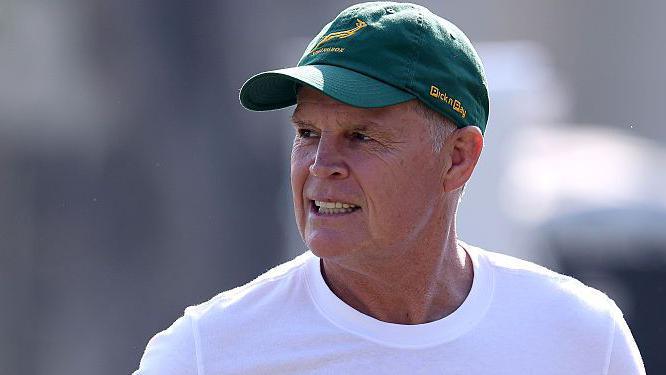 Image source, Getty Images
Wales beat South Africa in Rassie Erasmus' first game in charge of the Springboks in June 2018 in Washington DC
Producing talented players is one thing, knowing when to trust them is another.
Shimange believes one of Springboks head coach Rassie Erasmus' greatest strengths has been building a squad rather than simply selecting a team.
"The depth charts are incredible," he said.
"One of Rassie's strengths is the ability to build a squad. Even if you're young... he'll put you in."
Shimange points to the rise of Sacha Feinberg-Mngomezulu - who made his South Africa debut after fewer than 20 senior appearances for the Stormers - as evidence that age and experience are no barrier if coaches believe a player is ready.
"The system works in terms of integrating players from overseas, looking at young players and filling them with more experienced players," he said.
"But it's easier when you're winning. There's depth and competition internally."
Moyo is simply the latest example.
His elevation after just 58 minutes of senior rugby would be almost unthinkable in most countries.
In South Africa, it is another sign of a system - and a head coach - willing to trust the work already done long before a player reaches Test rugby.
The factory still isn't full
For all the success South Africa has enjoyed, Xabanisa believes the production line is still operating below its potential.
He points to two-time World Cup winner Makazole Mapimpi, who emerged from rural South Africa despite growing up far from established rugby strongholds.
"The great irony, or scary thing for the rest of the free world, is that there are places we could still tap into - more markets that haven't been tapped," Xabanisa says.
"If you think back to where someone like Makazole Mapimpi came from, the rural areas from which he came, there are no rugby structures there.
"Those people are as passionate about rugby as anybody else, but they don't have an obvious pathway.
"The day we work that out too, it could be a scary one for the rest of the free world."
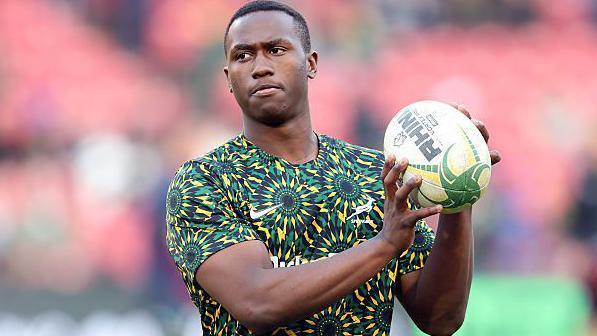 Image source, Getty Images
Vusi Moyo has been capped by South Africa Under-20s
South Africa's production line shows no sign of slowing. These are the young players repeatedly highlighted to BBC Sport as the next generation of Springboks.
Vusi Moyo (fly-half, Sharks, 20)
Starts at 10 against Wales, Moyo is regarded as one of South Africa's brightest young playmakers and one of the standout talents of his generation.
Riley Norton (lock, Stormers, 20)
The Junior Springboks captain chose rugby over cricket after representing South Africa at the Under-19 Cricket World Cup. A line-out leader and modern lock tipped for a long Test career.
Yaqeen Ahmed (fly-half, Lions, 20)
The Junior Springboks' fly-half is admired for his composure, kicking game and game management, with many viewing him as another future Springbok number 10.
Zekhethelo Siyaya (full-back, Sharks, 20)
Nicknamed 'Scrum Cap' because of his trademark headgear, Siyaya is an elusive broken-field runner with blistering acceleration and genuine X-factor.
Jacobus de Villiers (loose forward, Stormers, 18)
The younger brother of Springbok Paul de Villiers, the highly-rated schoolboy has already signed for the Stormers and is considered one of South Africa's leading loose-forward prospects.
 English (US) ·