
 3 months ago
67
3 months ago
67
ARTICLE AD BOX
2 hours ago
Lyse DoucetChief international correspondent, reporting from Tehran

 Getty Images
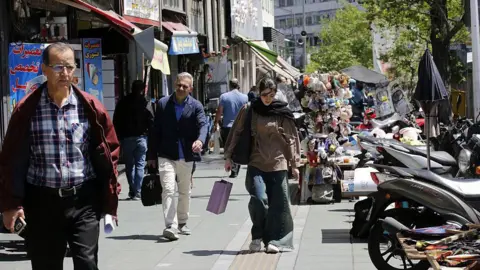
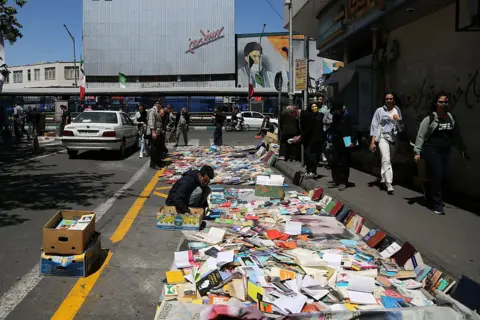
On a bright Tehran spring day, Sanaei Ghaznavi street, with its mix of shops selling groceries and household goods alongside fast food and flowers, seems like an everyday place.
In a country where lives have long been buffeted by crises, it is a snapshot of a people just trying to get through the day while their future hangs on forces beyond their control.
For Mohammad, in t-shirt and jeans, even cranking open the striped awning of his family's shoe shop is an act of hope.
"It makes me happy to be in here," he tells us when we wander into his pocket of a store with its floor-to-ceiling shelves of trainers, big and small. "So many people have lost their jobs and aren't working."
And there are few customers.
"We had so many before," his father Mustafa laments glumly as he proudly explains this business has been in their family for 40 years.
One Iranian website, Asr-e Iran, recently cited an unofficial estimate that up to four million jobs may have been lost or impacted by the combined effect of the war and the government's near-total internet shutdown.
 Getty Images
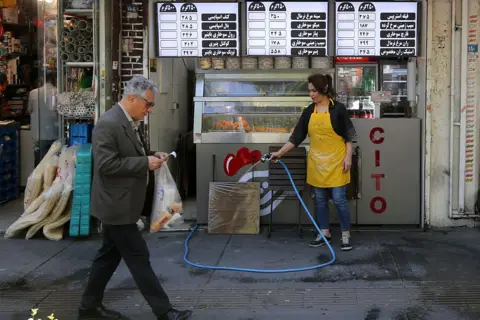
Boxes labelled with western logos like New Balance and Clarks protrude from this shop's packed shelves. "Made in China," both father and son note matter-of-factly. "Even fakes are expensive in Iran," Mohammad adds.
I expect them to express hope that the shaky ceasefire will hold, and that negotiations with America will succeed, in order to allow them to import the real deal when it comes to the latest fashions in footwear.
"We hope the war starts again," Mohammad declares, breaking into a wry smile. His father eyes knowingly his 27-year-old son. "Look at my grey hair, I understand more than him."
"We're just tired of living with an economy which keeps getting worse," Mustafa says. "Some people believe that, if war returns, things will eventually improve dramatically."
Outside the nearby corner shop, Shahla, an elderly woman wearing a pale headscarf balances a loaf of bread on a clipboard securing her shopping list and a wadge of bills.
She stops in her tracks when she sees us walking by and offers her thoughts.
"People are paying three times more for a loaf of bread now," she moans, her fingers resting on the soft white slices inside the plastic. "People are going through hell now just to pay for bread."
 EPA
EPA
She casts her eyes across this leafy street in central Tehran, which sits midway between the affluent north with its glittering shops and chic cafes, and the poorer, more conservative south.
"People who are well off, they're okay, but not for workers who don't earn much," Shahla spells out.
I ask what her message to the negotiators is.
"Stop it, that's enough," she declares. "I don't think something good will come of it for us because Trump is just threatening people."
As she makes haste to finish her shopping, a young man wanders past clutching a small glass bottle of a green spread.
"It's valak butter," he says, using the Persian word for wild garlic, which thrives in the foothills of the snow-capped Alborz mountains to the north. "I made it myself."
"We're just trying to live our lives, making things to enjoy," the 45-year-old architect and teacher explains stoically.
He does not want to be drawn into the "super complicated" politics in Iran and the wider region, or predictions of what could happen next.
But he vents his frustration that he cannot even access a website to translate words while he was reading a book because of the digital shutdown, which has now been in force for more than 50 days.
Even Iran's communications minister Sattar Hashemi recently called for the ban to be lifted, highlighting that around 10 million people, mainly from middle and lower-income groups, depended on digital connectivity for their work. He called it a "public right".
Restrictions are slowly and selectively easing – although the message from security officials is they will stay in force as long as "enemy threats" remain.
 Getty Images
Security has visibly tightened. We feel it on this street too.
Plain-clothed security - from the paramilitary volunteer Basij, or the Islamic Revolutionary Guards - are ubiquitous now.
A short drive away on Ferdowsi square, a few hulking black armoured vehicles flanked by armed men in uniform send an even starker message.
Like this street, that square is also named after a much-loved Persian poet.
I ask the architect what one change would make a big difference in his life.
"Freedom" is his fast, firm reply. "Freedom of thought and freedom to have a future."
Down the street, a popular cafe is bursting with customers waiting to purchase its famous grilled sandwiches and iced coffee. Even in this crisis, Tehran's cafe culture survives.
A row of counter seats along a wide-open window gives its patrons a ringside seat to watch street life go by.
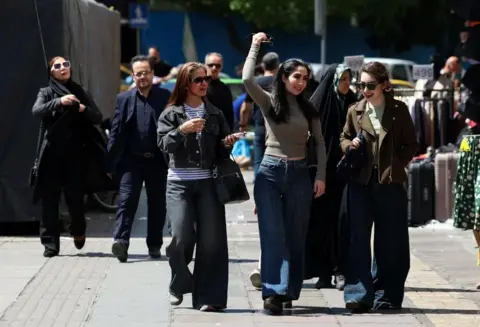
In this city, the contrasts are stark. Women in headscarves and long coats share the sidewalk with groups of young men and women in baggy jeans with body piercings and tattoos.
 Getty Images
Many women, young and old, no longer comply with laws dictating that they dress "modestly" and cover their heads, a legacy of the "Women, Life, Freedom" protests which swept Iran a few years ago - and like all protests, were crushed with lethal force.
Small demonstrations against the rising cost of living in late 2025 built into a nationwide outbreak of anti-government protest earlier this year, with several thousand people killed in the resulting security crackdown.
The recent war is on Ali's mind as he smokes imported Napoli cigarettes with a friend.
His sister has squeezed in alongside them with her short cropped hair and trendy turquoise spectacles.
"It was scary during the war," Ali recounts. "We felt alone. Our families were in other Iranian cities and we couldn't reach them."
Their future prospects are scary too. His sister tells us she just quit her job as a chef because the restaurant's owner said he could no longer pay her.
"I love President Tump and I hate President Trump," Ali announces. "I love him because he said he would help the people of Iran. I hate him because he didn't."
As the sun sinks, we drive to one of many nearby squares where government supporters have been gathering nightly in response to their new leaders' call to show defiance and solidarity.
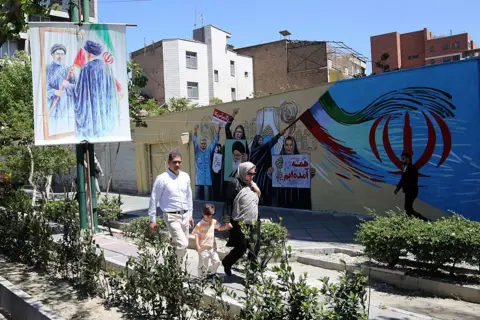
In Vali-e Asr Square, there is a thicket of Iranian flags set against the backdrop of a new towering mural of the former supreme leader Ayatollah Ali Khamenei, assassinated by Israel airstrikes in the very first hours of the war on 28 February.
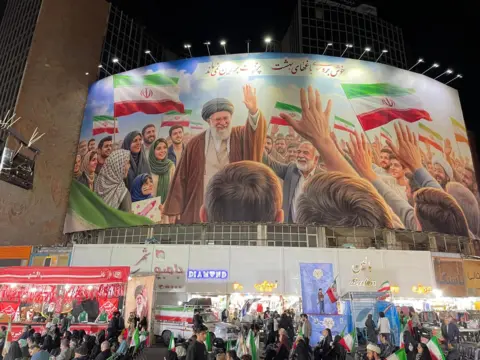
Tonight, rows of chairs stretching across this space are filled for an open-air debate on issues such as whether their late leader had approved negotiations with America.
One woman, veiled in black, a flag draped across her shoulders, rises from her seat and stridently takes issue with the moderator on stage, who had informed this crowd that the late ayatollah opposed talks with the enemy but then later approved them.
"Things were different then," she shouted, stressing that their late leader never trusted the West and knew his negotiators would be proven wrong.
A short time later, the topic shifts. Another woman takes the microphone and highlights the importance of hijab - head coverings for women.
"But we shouldn't be so tough towards those who don't want to wear it, I think it is a time which calls for national unity," she advises in an unexpected sign of openness.
A young woman, also in black and bearing a flag, approaches us to declare in English: "We only negotiate with President Trump from our position of strength."
Nineteen-year-old Reyhaneh, who is studying microbiology at the University of Tehran, also holds a photograph of the new supreme leader Mojtaba Khamenei.
She bats away my question that no one seems to have seen him since he was seriously injured in the attack which killed his father.
"Everything is in his hands now, and in the future too," she insists.
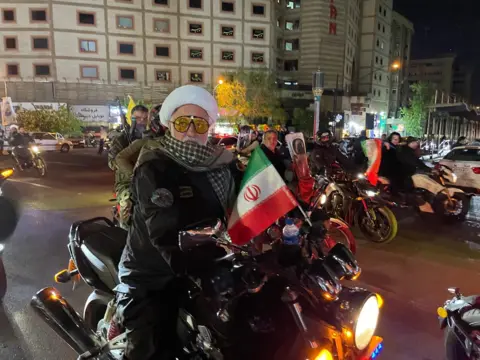
As we leave the square, there is a sudden roar.
A convoy of white and black turbaned mullahs in camouflage, guns strapped across their chests, growls past in a parade of motorcycles - another startling moment of this night.
Our journey takes us down Sanaei Ghaznavi street again.
At 22:30 on this warm spring evening, small knots of young people are still hanging out by the fast food restaurant and a cafe across the street.
We spot Mustafa the shoe salesman on the sidewalk outside his brightly lit shop, chatting with a few friends.
Had there been many customers today?
"Not many," he says with a shrug. "We just want this war to end."
The BBC's chief international correspondent Lyse Doucet is reporting from Tehran on condition that none of her material is used on the BBC's Persian Service. These restrictions apply to all international media organisations operating in Iran.

 English (US) ·