
 1 month ago
66
1 month ago
66
ARTICLE AD BOX
Just now
David KnoxBBC Scotland News, Peebles

 BBC
BBC
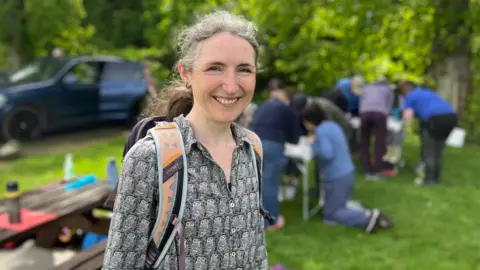
Conservation management student, Anna Dorward, took part in the Peebles training
A safety net against water pollution is widening across the country thanks to a growing army of fly-counting volunteers.
More than 60 groups of voluntary river detectives have now been formed since the Riverfly Partnership scheme arrived in Scotland four years ago.
By regularly monitoring the invertebrate life in rivers and burns, any deterioration in water quality can quickly be detected.
This year's training has just started for the latest monitoring volunteers in a bid to expand the early warning system even further.
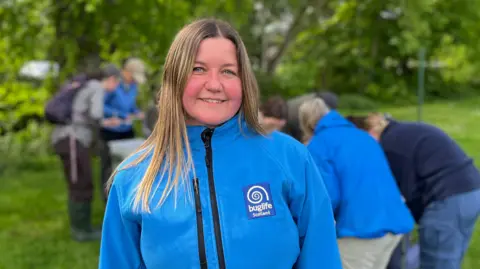
Elaine Rainey said changes could be reported quickly to the Scottish Environment Protection Agency
The riverfly monitoring programme started in England about 20 years ago and Buglife was tasked with expanding it into Scotland in 2022.
By surveying numbers of invertebrates, such as caddisflies, mayflies and stoneflies, and submitting the data, any changes of water quality can be quickly detected
Most river catchments in Scotland now have at least one monitoring group - from Abhainn Gleann Leircag and the Mosset Burn in the north to the rivers Cree and Tweed in the south and more than 1,000 surveys have been logged.
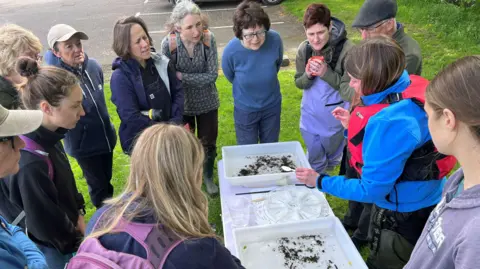
Buglife trainer Elaine Rainey with the latest volunteers in Peebles
Conservation officer Elaine Rainey said any changes picked up were passed on to the Scottish Environment Protection Agency (Sepa) immediately.
"We will continue to expand the programme by offering training and providing kits for new monitoring groups," she said.
"People across Scotland are building connections with their rivers and burns - and we are all benefiting from this interest."
In the Borders, Buglife has teamed up with the Tweed Foundation (TF) to expand its monitoring.
There are currently six groups - in Peebles, Jedburgh, Ancrum, Heriot, Earlston and Walkerburn - with further training courses for new groups about to take place in Coldstream, Eyemouth and Innerleithen.
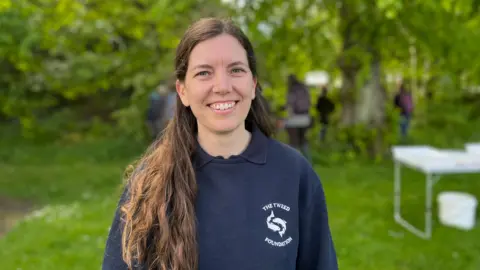
Erica Chapman is volunteer co-ordinator with the Tweed Foundation
Marine biologist Erica Chapman, who is the TF volunteer co-ordinator, said it let everyone play their part in protecting river health.
"People consider riverflies to be the canaries of the our water courses - if they are not there, then something is wrong," she explained.
"While Sepa do their own regular monitoring of rivers, this fills in the gaps and allows everyone to react quickly if something is going wrong."
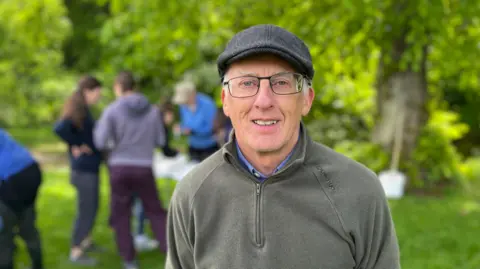
Keen angler Neil Macintyre took part in the Peebles training session
As well as monitoring the eight target invertebrates, the river detectives are trained in spotting non-native species, such as demon and killer shrimps.
Angler Neil Macintyre was among 12 volunteers who helped identify and count the flies at a recent Eddleston Water training session.
"I am interested to find out a lot more about the invertebrates that live in the water and also play my part in keeping the river healthy," he said.
"Being an angler for such a long time I knew a bit about the invertebrates, but this training has taken my knowledge to a new level."
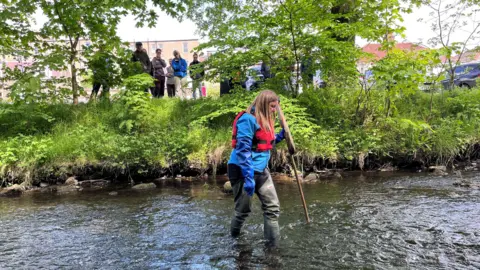
Elaine Rainey, from Buglife, provides a demonstration on the Eddleston Water of gathering samples
Anna Dorward from Dalatho, who is a conservation management student, signed up as she lives near the Tweed.
"We take samples from the same part of river each month and then separate out the different invertebrates into a tray and count them," she said.
"It's the sorting out I like the best - my identification is getting better and I love doing it."






 English (US) ·