
 2 months ago
66
2 months ago
66
ARTICLE AD BOX
13 minutes ago
Faisal IslamEconomics editor

 Getty Images
The British economy is showing far more resilience than expected by many economists, including the IMF which suggested the UK would be hardest hit by the Iran war.
It's worth diving into some of those numbers in more detail to get a better sense of how the economy is going – and importantly, what people think about it.
Here are six charts that explain what is going on.
1. The economy was strong, despite Iran war
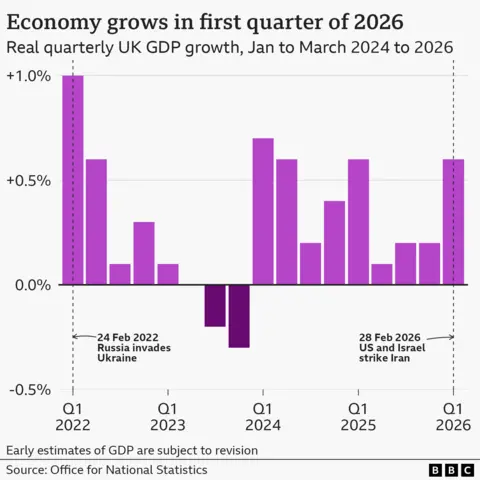
The latest set of official economic numbers show the economy grew by 0.6% in the first quarter from January to March, notably higher than recent sluggish history.
This is a solid number, and rather good in the circumstances of the Iran war raging in the last month of the time period.
It is worth noting, however, the pattern in recent years of a fast start to the year which can fade.
2. Growth per person was healthy too
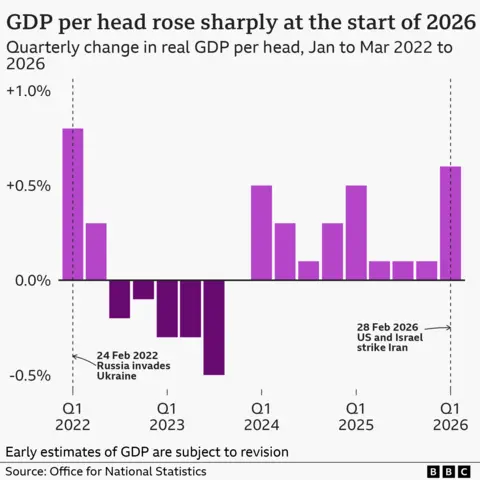
These numbers can be boosted by population growth: more people working means more economic activity, which generally means more growth.
So one way to measure whether people are doing better on average is to adjust economic growth by the number of people, using GDP per capita.
That has been even slower in recent years, reflecting stagnant living standards.
The latest figures were however the fastest for four years, since the start of the energy shock after Russia invaded Ukraine.
3. UK compares well to other advanced economies
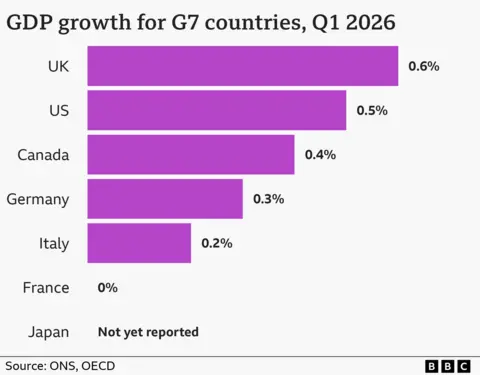
Every nation in the world has been hit by the Iran War, so it is interesting to compare the UK with the rest of the G7.
It is currently the fastest growing of these major economies - while Japan has not yet reported, its growth figure is expected to be lower than the UK.
The IMF prominently forecast last month that the UK would be the hardest hit economy in the G7. It's early days, but that has not come to pass yet.
This is possibly because household domestic energy bills have been protected.
But it may also be the case that this energy shock, which is more about oil than gas, has affected the UK less as Britain has become less sensitive to gas prices in recent years.
4. Some industries helped the economy grow
There was growth across the board in services, construction and manufacturing. The boost to wholesale and retail trade suggested a more resilient consumer.
Professional scientific activities and information and communications did well, which chimes with a lot of strong investment news, verging on boom territory in the UK AI and tech sector, nicknamed "Britmaxxing".
5. Other sectors struggled
There are some concerns emerging however, as to be expected from the rise in fuel and chemical costs.
The machinery and equipment sector fell, administrative services activities did too.
A sector to watch is house building, especially given the rise in fixed mortgage rates.
6. Consumers are feeling less confident
Resilience has been impressive so far, but the very latest consumer confidence shows the impact of rising fuel and mortgage costs, which is likely to weigh on growth.
Little wonder that the chancellor and PM are eagerly hoping for an end to hostilities in the Gulf, and a reopening of the Strait of Hormuz.
While the UK economy was starting to recover at the start of the year, events in the Gulf still might scupper that.







 English (US) ·