
 2 months ago
64
2 months ago
64
ARTICLE AD BOX

 AFP
AFP
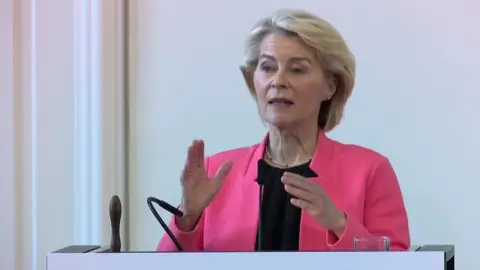
Ursula von der Leyen introducing EU plans for children's online safety
European Commission President Ursula von der Leyen has proposed a "social media delay" for children in Europe and has said new legislation could be put forward in months.
She told an EU summit in Copenhagen that an expert panel was due to come up with steps on how to protect minors online by July.
Several countries in Europe and around the world have already introduced social media bans for minors, and von der Leyen did not rule that out.
"The discussion about a minimum age for social media can no longer be ignored," she said.
Denmark, where Tuesday's summit was being held, and nine other EU member states including France have proposed various minimum age limits for access to platforms.
Australia became the first country in the world to introduce a ban for under-16s last December and European countries are planning to follow suit.
In the UK, plans are under way for strict social media regulations, also for under-16s. This entails potential bans, age verification and content restrictions. A major national consultation is due to close on 26 May 2026.
France is pushing to ban social media access for children under 15, aiming for implementation by September this year.
In Spain, there are plans to ban social media access for under-16s, to combat addiction, pornography, and harmful content.
The Portuguese government passed a bill earlier this year requiring parental consent for users aged 13 to 16 and strengthening restrictions on those under 13. The plan includes mandatory age-verification technology.
Plans are being formed by the German government focusing on a potential ban for children under 14, with restrictions for teenagers up to 16. Key measures include enforcing strict age verification, creating "safe" youth versions, and removing addictive algorithms.
Norway plans to introduce a strict social media ban for under-16s by the end of 2026. The legislation will require technology companies to implement age verification systems.
New Zealand, Malaysia and India have all proposed social media bans for children as well.
The EU has been at odds with social media platforms over the last years, and von der Leyen made clear that age restrictions would not mean that tech companies were being "let off the hook".
"The question is not whether young people should have access to social media. The question is whether social media should have access to young people", she said. "Let us give childhood back to children."
In its role as the EU's digital watchdog, the Commission has already conducted intense investigations into major social media platforms, using the Digital Services act, aimed at enforcing stricter child safety rules.
Last month, the Commission found that Meta's Instagram and Facebook had breached the act for failing to keep under 13s off their platforms. In February the EU threatened heavy fines on Chinese-owned TikTok if it did not change its "addictive design".
The EU's bid to crack down on social media companies has been heavily criticised by the Trump administration in the US. When Elon Musk's platform X was fined last December, the US accused the Commission of attacking and censoring US firms.
Several prominent European figures were then barred from entering the US, including ex-EU commissioner Thierry Breton. US Secretary of State Marco Rubio complained that "ideologues in Europe" had sought to force American platforms to punish American viewpoints they opposed.
Von der Leyen said on Tuesday that the EU had "set rules. It's the law, and those who break it will be held accountable".

 English (US) ·