
 3 months ago
70
3 months ago
70
ARTICLE AD BOX
Clive MyrieBBC News, Abu Dhabi
UAE Minister told the BBC she was 'not aware of all details' on arrests
The UAE's Minister of State, Lana Nusseibeh, has called on Iran to end its strikes on countries in the region and vowed that her country would "bounce back".
More than 1,800 drones and missiles have been projected at the UAE since the war began, she said.
The extent of the attacks came as a "shock", she told the BBC.
Some of the UAE's best known buildings have been damaged - including Fairmont The Palm hotel, in the luxurious Palm Jumeirah area, and the Burj Al Arab hotel.
Drones have landed near the Dubai International Airport and thousands of flights to the UAE have been cancelled.
However Nusseibeh refused to be drawn on whether her country would retaliate militarily against Iran.
"We were clear prior to the start of this escalation that the UAE would not allow its territory or airspace to be used in any attacks against Iran," she said.
Asked if retaliatory strikes were off the table, she replied: "We will reserve the right for collective self defence under international law."
Other Gulf states including Qatar, Saudi Arabia, Bahrain, Kuwait and Oman have also been targeted by Iran as it retaliates in response to US and Israeli attacks.
Trade through the region's biggest port, Jebel Ali in Dubai, has also been affected and the war has halted most shipping through the Strait of Hormuz at the mouth of the Gulf.
The UAE's biggest city Dubai has also cultivated a reputation as a glamorous and attractive destination for expats pursuing business opportunities and travel.
However Nusseibeh, who was also formerly the UAE's ambassador to the UN, insisted that her country's economy would recover.
"Iran is responsible for damage it has caused. The civilian infrastructure, the hotels, the ports," she said.
But she said the UAE was "resilient" and, citing economic growth of 5.1% last year, insisted "you will see our economy bounce back".

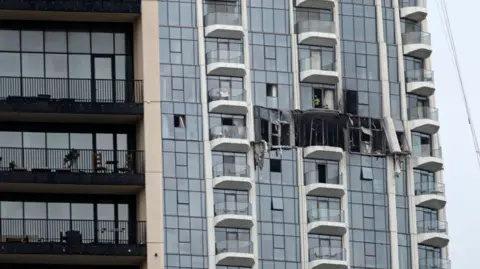 EPA
EPA
Dubai Creek Harbour Tower after it was hit by an Iranian drone attack on 12 March
But she denied it was an attempt to avoid painting a true and troubling picture of what life was currently like in the UAE.
"In order for everyone to feel safe, it is very important at this time, that the information is credible and the sources are reliable," she said.
"That is the basis of the legislation that has come into play in the state which is obviously a tense time."
She added that she was "aware there have already been some violations of this law".
Criticism of the government is illegal in the UAE, and it exercises strict control over the flow of information out of the country.
UK-based human rights group Amnesty International has said the UAE has "continued to criminalise the right to freedom of expression through multiple laws and to punish actual or perceived critics of the government".
However Nusseibeh advised people in the country to follow the guidelines "for your safety. And for your protection".


 English (US) ·