
 2 months ago
81
2 months ago
81
ARTICLE AD BOX

 Getty Images
Rescue teams combed the mountainside where the crash happened
A Boeing 737 plane that plummeted into a Chinese hillside in 2022, killing all 132 people on board, had its fuel supply cut mid-flight, according to newly released data by the US National Transportation Safety Board (NTSB).
Findings by the NTSB say that the fuel switches on both engines of the China Eastern flight were moved to the "cut-off" position while it was at a cruising altitude of 8,839m (29,000ft) - supporting a theory that the crash was intentional.
The crash is the country's deadliest air disaster in decades, though the cause of the incident has long remained a mystery.
China has yet to release a final report on the incident, citing national security concerns.
The NTSB report, which was released under the Freedom of Information Act, said that the MU5735's engine speeds "decreased after the fuel switch movement".
Fuel switches are controls that regulate fuel flow into a plane's engines, used by pilots to start or shut down engines.
The newly released data was taken from one of the plane's so-called "black boxes", which record all relevant operational information. The black box was recovered from the wreckage of the plane crash and sent to the NTSB's laboratory in Washington DC for analysis.
In March 2022, the jetliner had departed from Kunming, the capital of Yunnan , and had been due to land in Guangzhou on the same afternoon.
It had been in the air for more than an hour and was nearing its destination when it suddenly plummeted from its cruising height - with flight tracker data showing that it dropped thousands of metres in under three minutes.
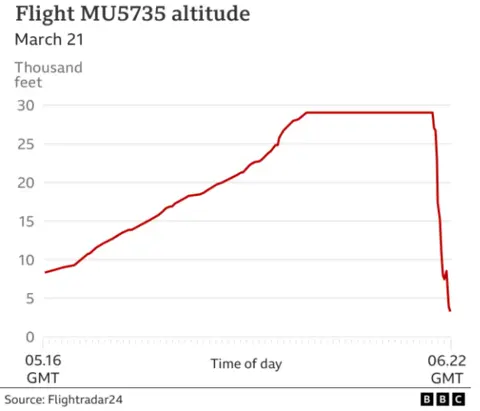
According to tracking site FlightRadar24, the plane was cruising at 29,100ft (9,000m), but two minutes and 15 seconds later it was recorded at 9,075ft. The last sourced information on the flight showed it ended at 14:22 local time, at an altitude of 3,225ft.
Because the incident took place in China and involved a Chinese airline, China's Civil Aviation Administration (CAA) led investigations. As the Boeing 737 was designed and built in the US, however, the NTSB appointed a senior air safety investigator to assist.
Investigators were expected to look at several possible causes - including deliberate action, pilot error, or technical issues such as a structural failure or mid-air collision.
Shortly after the crash, Zhu Tao, aviation safety office director at the CAA told reporters that they did not have a clear assessment of the cause for the crash.
Air controllers had repeatedly called the aircraft during its descent but had received no response, he added
But the CAA maintained that the crew held valid licences, were adequately rested and passed health checks on the day of the flight.
Multiple media outlets had previously speculated that the plane crash was intentionally caused by someone in the cockpit – but this remains unconfirmed.
The CAA previously issued a denial amid speculation that the crash was a case of pilot suicide.
"These rumours…have seriously misled the public and interfered with the investigation of the accident," Wu Shijie, a CAA official, told a press conference in April 2022.
China has been criticised for not releasing a final report on the incident, while the CAA has warned that "disclosure [about the crash] may, if released, endanger national security and social stability".
Airplane crashes are rare in China, where air safety and aviation standards have improved vastly in recent decades.






 English (US) ·