
 10 hours ago
12
10 hours ago
12
ARTICLE AD BOX
4 hours ago
Ione Wellsin Bogotá, Colombia

 AFP via Getty Images
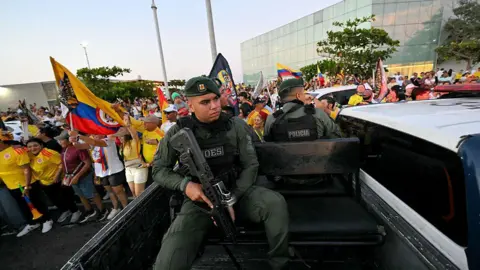
Escalating violence has marked Colombia's presidential campaign
"My brother was murdered for not paying an extortion payment...in front of his children," Edilma Martinez Flores said at a support centre for displaced people in Bogotá.
She fled her home on the outskirts of Cali, in the south-west, after armed criminal groups handed out leaflets ordering residents to leave or face violence.
"We had no choice but to leave our things behind. They started placing bombs along the routes people travel."
Edilma is far from alone, and experiences like hers are why insecurity is dominating voters' minds in Sunday's key presidential election.
Colombia's six decades of conflict between armed groups, the state and cartels has killed hundreds of thousands of people.
It isn't new, but illegal armed groups have roughly doubled their membership in the last five years.
These include Revolutionary Armed Forces of Colombia (FARC) dissident factions, the National Liberation Army (ELN) and the Clan del Golfo, who have expanded their control of rural areas key to drug trafficking and illegal mining.
 AFP via Getty Images
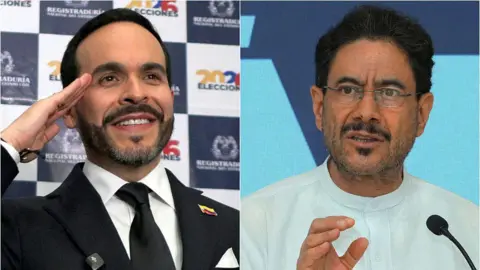
The outsider Abelardo de la Espriella (left) wants to build mega prisons for gang members and has Donald Trump's endorsement, while senator Iván Cepeda (right) wants more negotiations with armed groups
A brutal offensive between the ELN and FARC dissidents near the Venezuela-Colombia border last year displaced tens of thousands of people.
The two presidential candidates have starkly different visions for tackling this violence, in a campaign marked by the assassination of a presidential candidate, homicides, kidnappings and bombings.
Left-wing senator Iván Cepeda is seen as the "architect" of the current president Gustavo Petro's "total peace" strategy, prioritising negotiation with armed groups. Critics say it has failed and let armed groups exploit ceasefires to expand their control. Supporters argue it prevents a larger loss of life.
He also played a key role in the 2016 peace deal which disarmed thousands of FARC fighters.
He has pledged "social transformations that the country urgently cries out for" while promising to "take stock" of the peace strategy and "make the necessary changes".
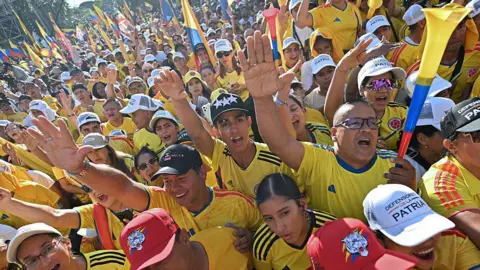
His challenger is a conservative outsider, right-wing businessman and lawyer Abelardo de la Espriella, who calls himself El Tigre (The Tiger in English). He's been endorsed by Donald Trump, and is a US citizen. The signature outfit for him and his supporters is the Colombian football shirt, which the left has accused him of politicising.
He has promised 10 mega-prisons, a tough military crackdown, and an end to negotiations with armed groups, saying he has the "balls" to take them on.
"Any criminal who does not surrender will be taken down," he has promised.
For many Colombians, how this issue is tackled will have a huge impact on their lives.
 AFP via Getty Images
Voters narrowly backed de la Espriella in the first round over Cepeda
Isabelita Mercado Pineda, a government advisor for peace, victims and reconciliation in Bogotá, says forced displacement rose 300% between 2024 and 2025.
"We have not seen displacements like this for the last two decades," she added.
She said it has been driven by factors including rising cocaine production, the army failing to occupy territories left by the FARC after it demobilised in 2016, leaving voids for armed groups to fill, and a "failure" of the government's strategy that she argued provides criminal groups with "carrot but not enough stick".
The support centre for victims in Bogotá shows the scale of this issue. Erin Gamboa from the Chocó region on the Pacific Coast said his half-brother was taken by FARC guerillas and they have not heard from him since.
"My region is heavily contested, criminal gangs fight over the territory," he said, outlining how paramilitaries, guerillas and the FARC fight over illegal mining and cocaine trafficking sites.
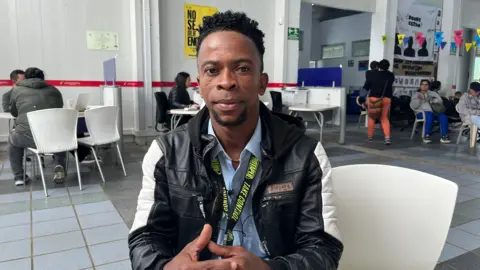
Erin Gamboa says armed groups took his half-brother
Another couple, who wanted to remain anonymous, said their small food delivery business was contacted by a man claiming to be from the FARC. He began extorting their children, demanding 5 million pesos (about $1,500; £1,100).
Through tears, the woman described how crime has grown "so much" and you "can't go out in peace anymore".
Trump's endorsement of de la Espriella, criticised by the left as foreign interference, comes as the US takes a more interventionist stance towards criminal groups in Latin America.
Trump said the election would determine Colombia's relationship with the US, adding that "if Abelardo wins…[Colombia] will have the total support and strength of the United States behind him", and called Cepeda a "radical left Marxist".
De la Espriella grew up on Colombia's Caribbean coast where he retains strong regional support.
Maria Luisa Sanchez, a childhood family friend and neighbour, said de la Espriella has "achieved everything he has set out in life, he is a man with very strong convictions".
"He has that character, courage, it's what we need for Colombia, a person ... who is tough on drug-trafficking, tough on guerillas."
Supporter Sandra Caballero, from a village outside of Barranquilla, said he "will work with the United States to fight drug trafficking and doesn't plan to speak with criminals – which has not given results in four years".
"He wants to change taxes to help companies generate more jobs and invest in security and health."
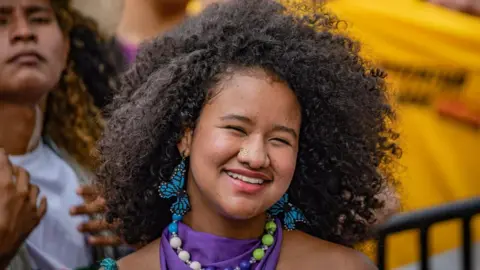
Young voters like Catalina back the left-wing candidate Cepeda
Cepeda, on the other hand, has the lead among younger voters in Colombia.
"Cepeda's proposal for security not only contemplates the coercive forces of the state to stop crime, but also takes into account the structural roots of insecurity - the lack of state presence, poverty, inequality, many young people belonging to criminal groups," student Catalina La Grande said.
"We don't want to repeat security models from previous governments that have left thousands of victims and not solved the problems. We believe in negotiated security: combining repression [of armed groups] with social programmes."
At a fanzone for Colombia's World Cup opener against Uzbekistan, which they won 2-1, a young woman Sofía Diaz said she was hopeful that her team – and Cepeda – would win.
"I'm more nervous about the elections. I like Cepeda's proposals, he's against fracking, he's fought for the country all his life."
The streets of Bogotá echoed with jubilatory cheers and vuvuzelas after Colombia's win: the sound of a country, briefly, very united.
With two very different candidates on the ballot, Sunday's election will make it far more divided.
Additional reporting by Vanessa Silva and Nathalie Jimenez


 English (US) ·