
 2 hours ago
6
2 hours ago
6
ARTICLE AD BOX
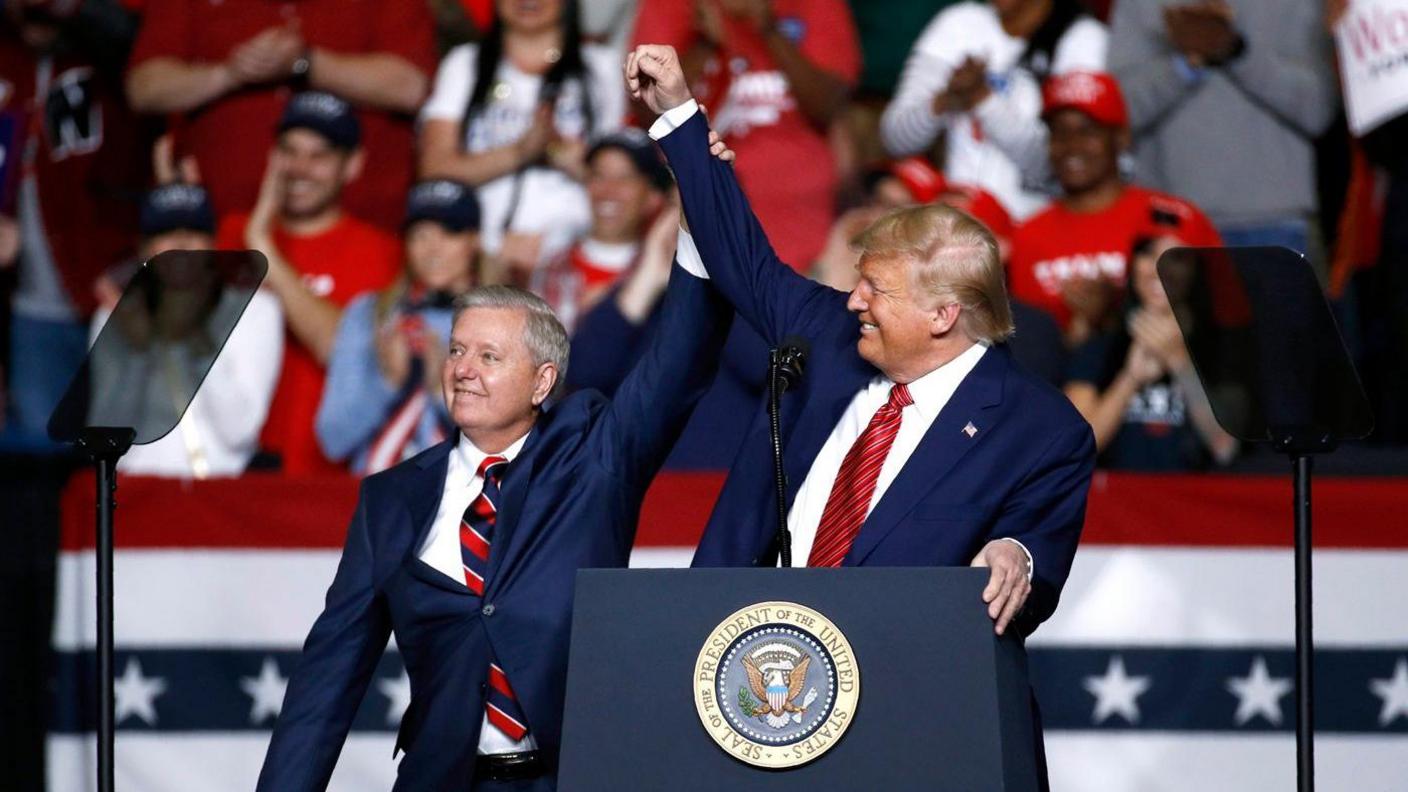 Image source, AP
By
North America correspondent
Lindsey Graham was a political survivor whose career as a Republican senator served as a telling barometer for the dramatically changing climate in his political party - and America - in the Donald Trump era.
While there were certain issues that were always central to Graham's political identity – including a hawkish foreign policy that focused on containing Russian global ambitions, support for Israel and regime change in Iran – his 23-year career in the Senate was marked by a willingness to adapt to the gale-force change of political winds that accompanied Trump's rise to power.
Shortly after being elected to represent South Carolina in the Senate in 2002, Graham became a close ally of Senator John McCain, the Arizona Republican who, while a staunch conservative, developed a national reputation for political independence.
When Graham ran for president in 2015, the idea of cooling partisan tensions and working with political opponents was one of his central messages.
"If I get to be president, we're going to open up a bar in the White House," Graham said. "We're going to get liquored up and solve problems."
He bristled when Trump criticised war-hero McCain for being a prisoner of war, with the New York real estate mogul telling a campaign event: "He's a war hero because he was captured. I like people that weren't captured." Graham called Trump a "jackass" who shouldn't be president.
Trump then read out Graham's phone number at a rally, which inundated the senator with angry calls and messages.
In response, Graham destroyed a collection of mobile phones in a stunt video.
A few months later, as his presidential campaign fizzled, Graham called Trump a "race-baiting, xenophobic, religious bigot".
That criticism would reach a crescendo in his famous Twitter post in May 2016 that if the Republican Party chose Trump as its nominee it "will get destroyed ... and we will deserve it".
Graham – like many national Republicans – stayed wary of Trump during his 2016 general election race against Hillary Clinton. He publicly announced he would not vote for either, instead opting for independent candidate Evan McMullin.
Once Trump secured victory, however, Graham changed his attitude.
As Trump consolidated his control over the Republican Party during his first presidential term, Graham became a close ally and, by all accounts, a friend.
The two men regularly golfed together, and the senator, who was always a fixture on cable news television, ardently defended the president and his policies.
When Trump picked Brett Kavanaugh to be his second Supreme Court appointment, Graham angrily condemned allegations of sexual assault made against the nominee, who denied wrongdoing. Through his intervention, Graham helped to ensure he was confirmed – albeit by the narrowest of margins.
'Count me out, enough is enough'
Graham broke with Trump, however, after he lost the 2020 presidential election to Joe Biden – a former Senate friend of Graham's who he once called "the nicest person I've ever met in politics".
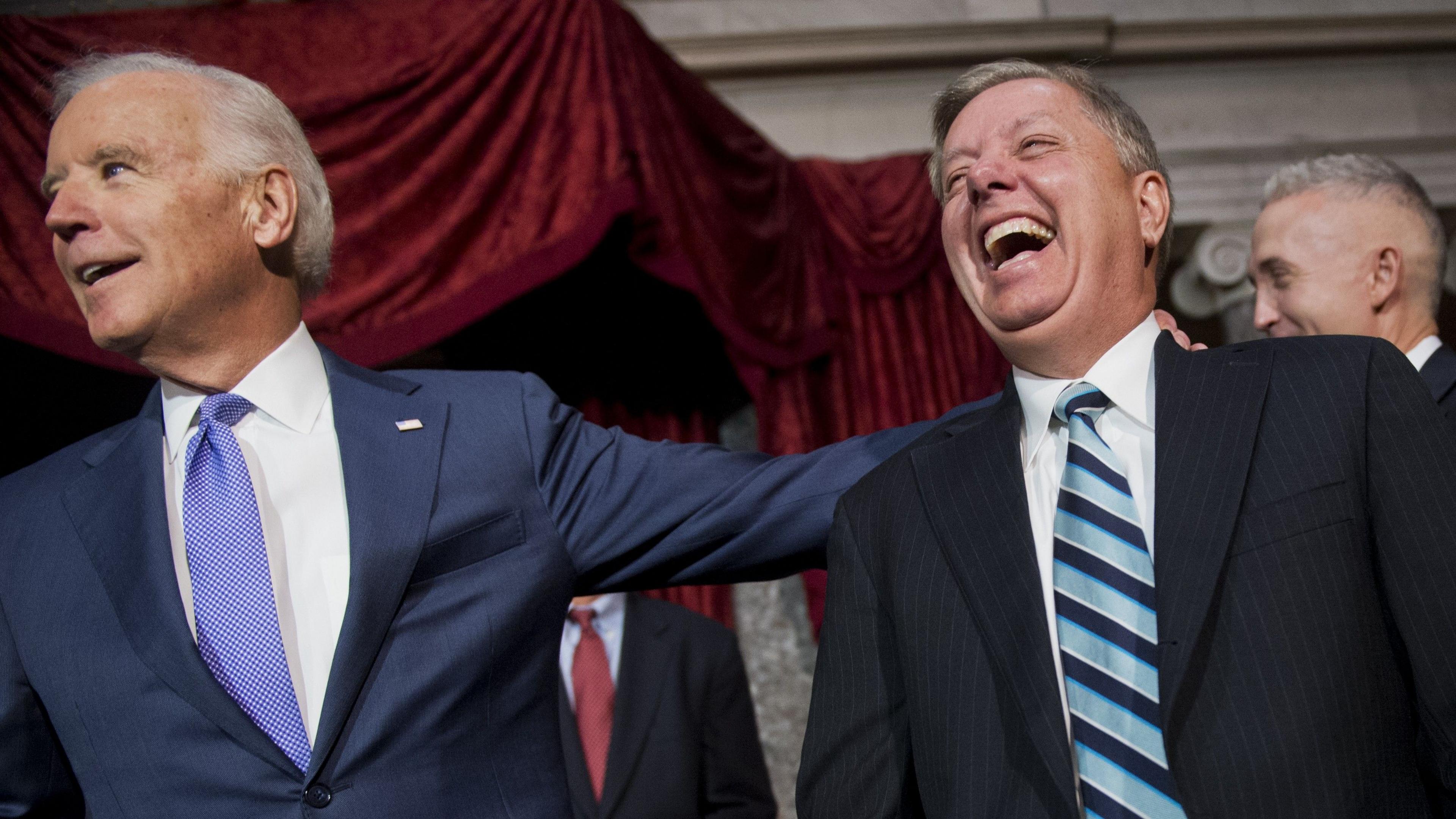 Image source, Getty Images
When a crowd of Trump supporters stormed the US Capitol on 6 January 2021, disrupting the election certification and forcing Graham and other legislators to flee, Graham said he was cutting ties with the soon-to-be-ex-president.
"Trump and I had a hell of a journey," he said. "I hate it to end this way... All I can say is count me out. Enough is enough."
Trump's political exile would prove to be only temporary, however, as would Graham's distance from him.
He voted to acquit Trump of impeachment charges in his February 2021 Senate trial. And as Trump began his steady march toward the 2024 Republican presidential nomination, Graham once again threw his support behind him – while explaining his previous break.
"He was a very good president from my point of view," Graham told the BBC in 2023. "I am judging him by what he did as president."
After Trump returned to office, Graham was a reliable vote for Trump's cabinet and judicial nominees and for his legislative agenda. He praised the president's military actions in the Middle East and, at times, gently encouraged him to continue the US strikes until Iran's regime collapsed.
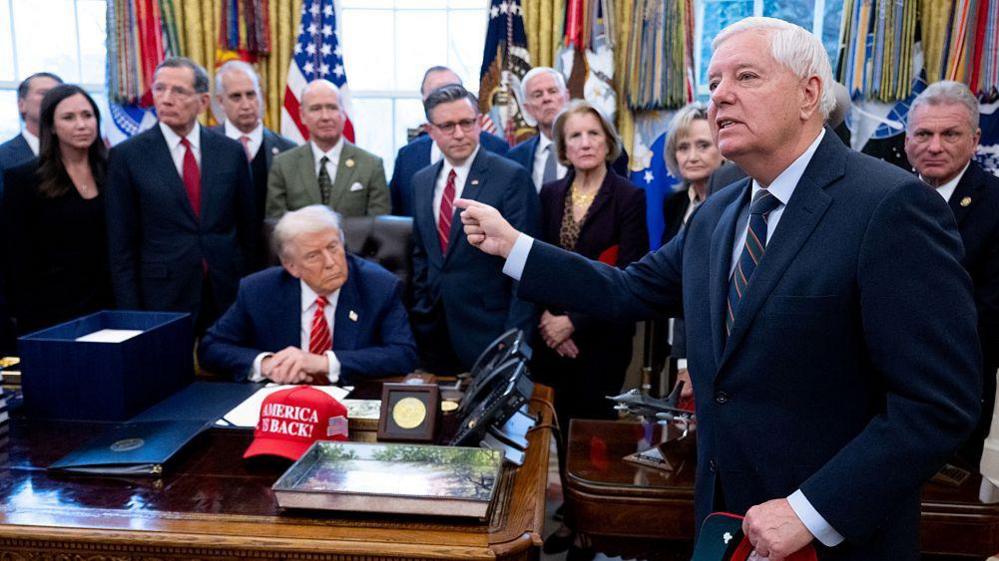 Image source, Getty Images
While he publicly called for greater US support for Ukraine in its war against Russia, he tempered his criticism of Trump's overtures to Russian President Vladimir Putin and declined to push new sanctions against the nation without the president's explicit approval.
Despite Graham's close ties with the president, he continued to maintain friendships with his Democratic counterparts in the Senate, as evidenced the growing list of statements of condolences following his death – including from outspoken Trump critics like Adam Schiff of California and Elizabeth Warren of Massachusetts.
"He was able to deal with Democrats," Trump said during a television interview on Sunday morning. "If I had a problem with a Democrat, he could work it out."
The race for a replacement
Graham's relationships with Republicans who, unlike him, did not shift to accommodate the changes Trump brought to the party were more complicated.
"Before Trump, we were friends," former Congressman Adam Kinzinger, who served with Democrats on the 2022 committee investigating Trump's role in the 6 January attack on the US Capitol, posted on X. "I choose to remember the man I knew before our paths diverged – the one who cared deeply about America's role in the world and wasn't afraid to see suffering up close."
Graham's sudden death will complicate Republican legislative strategy – including efforts to pass new spending legislation and approve Trump's choice for attorney general, Todd Blanche.
It also leaves South Carolina Republicans scrambling: the 71-year-old senator was in the midst of running for another six-year term and had won his party's nomination unopposed.
Republican Governor Henry McMaster will now appoint a replacement for Graham for the rest of the year, and the party will hold a new primary to choose a candidate to stand in November's general election.
While South Carolina is a reliably conservative state, if Trump's disapproval ratings remain high and Republicans continue to face strong political headwinds, they may have to commit more resources to defending what is now an open Senate seat.
Whoever follows Graham will be a junior senator without the decades of influence, seniority and access to the corridors of power that Graham built - and maintained - during one of the most tumultuous periods of American politics in the modern era.



 English (US) ·